
Companies Using AI in Every Task: What the Surveys Show
Most companies use AI for a few tasks, not every task
Companies are not using AI in every task yet. Surveys of larger organisations report that about four in five use AI somewhere, government surveys of all businesses find about one in five, and in both the use clusters in a few functions: sales and marketing, writing and document work, IT and customer service. The financial gains companies report are real, and mostly small.
The original version of this post promised a future where AI runs every process. This version sticks to what companies report doing now, from four sources you can open: Stanford's AI Index, the US Census Bureau's business survey and a Census research paper, and Eurostat's survey of European enterprises. Each number below links to the page that published it.
If you want AI in more of your company's work but do not know which task to start with, we can find the one with the clearest payback. Book a call with GenovaFlow AI
One survey says 78% and another says 20%, and both are right
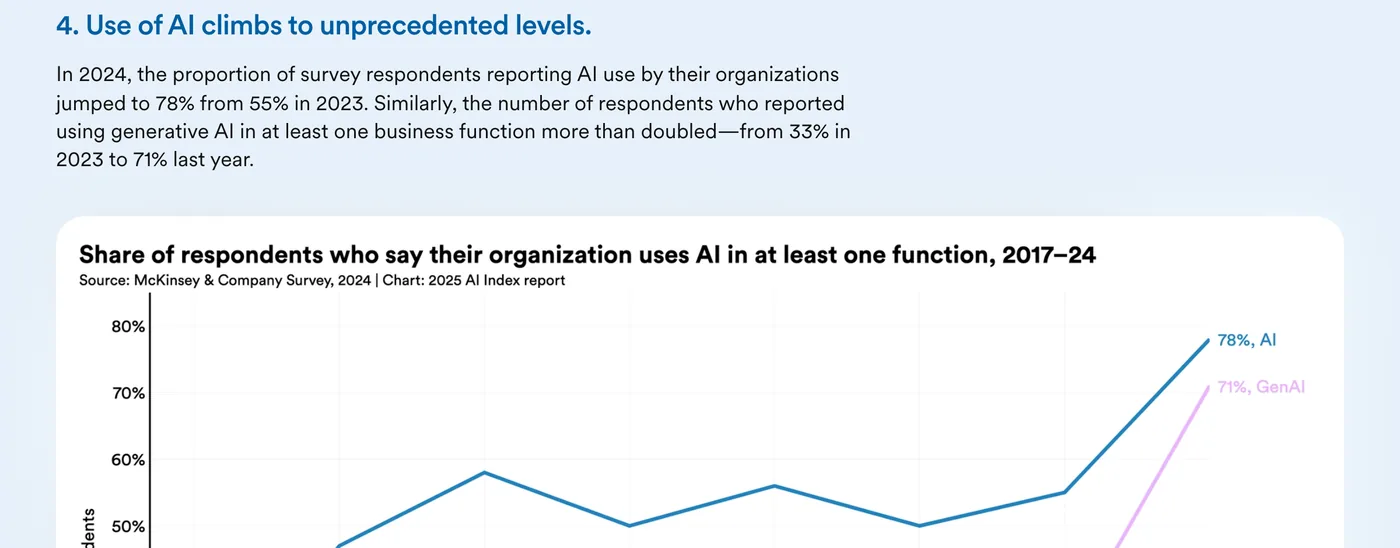
The headline figure most people quote comes from a McKinsey survey charted in the 2025 AI Index. In 2024 78% of respondents said their organisation used AI, up from 55% in 2023, and the share using generative AI in at least one business function more than doubled, from 33% to 71%.
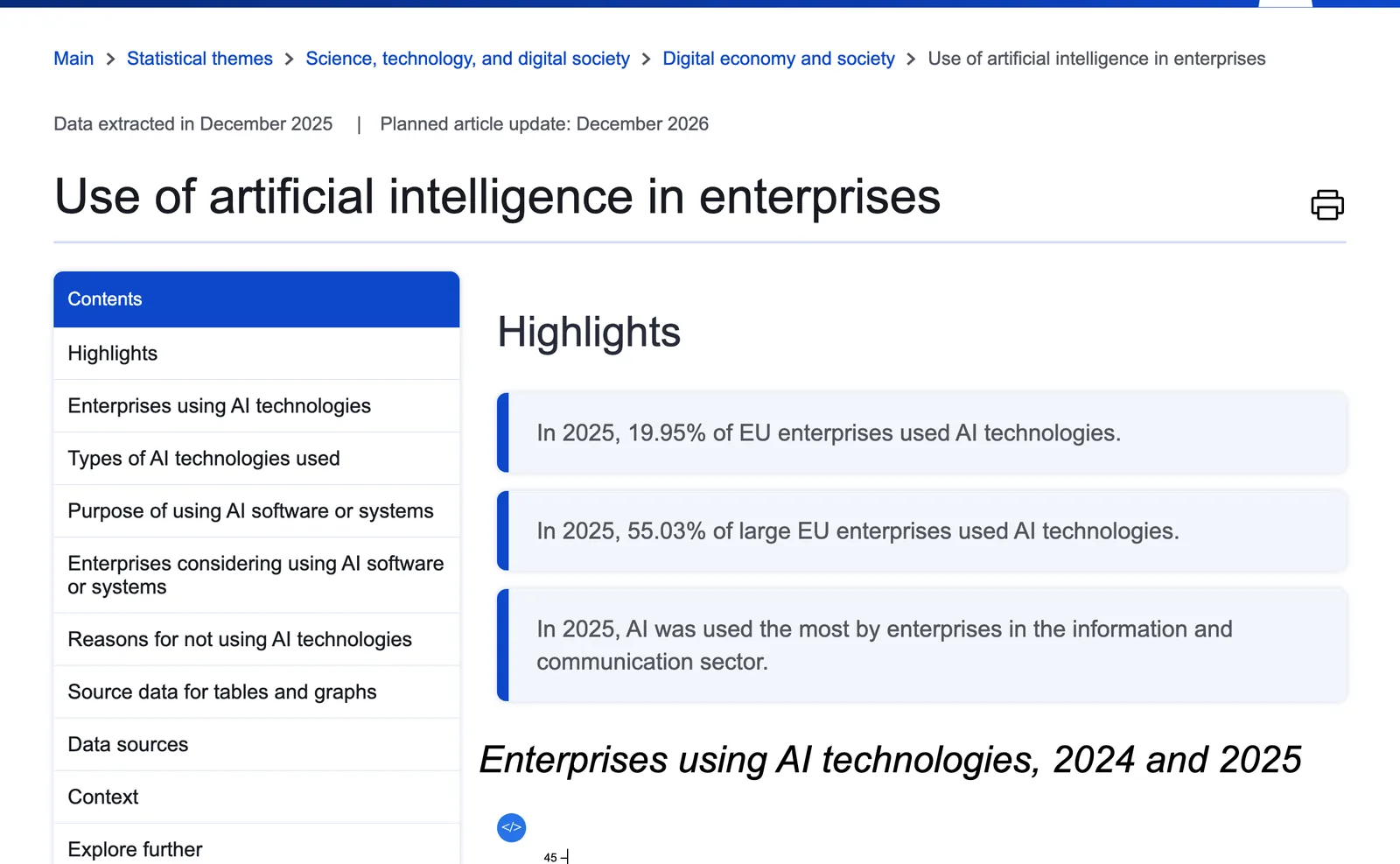
Government statistics, which sample businesses of every size, find much lower numbers. The US Census Bureau's Business Trends and Outlook Survey shows that AI use hovered between 17% and 20% of businesses from December 2025 to May 2026, with 37% of firms of at least 250 employees using it and fewer than 20% of firms with four or fewer. Eurostat found that 19.95% of EU enterprises with ten or more employees used AI in 2025, rising to 55.03% among large enterprises and falling to 17% among small ones.
The gap is mostly about who is counted. A survey of managers at large organisations asks whether AI is used anywhere in a big company, and the answer is almost always yes. A national survey asks every kind of business, and most businesses are small. If you run a company with twenty people, the second number is the one that describes your competitors.
The national numbers are moving, though slowly. In the same Census survey, between 20% and 23% of businesses expected to be using AI within six months, and the sectors ahead of the average were Information at 39.7% and Finance and Insurance at 33.9%, while Retail Trade sat around 14%. Use rose among firms with at least 20 employees and did not change significantly among smaller ones.
AI shows up first in sales, marketing, writing and IT
When companies do adopt AI, they start in the same places. A Census Bureau working paper found that, among firms using AI, the leading business functions are sales and marketing (52%), strategy and business development (45%) and IT (41%), and that writing, document analysis and information search are the leading generative AI tasks. Across all firms, it measured 18% using AI in a business function, or 32% when weighted by employment.
European data points the same way. Of the EU enterprises using AI, 34.70% used it for marketing or sales and 31.05% for business administration or management, while logistics came last. The pattern makes sense: these are the tasks with the most text, the most repetition and the clearest way to check the output.
That is also where AI agents, as opposed to chat tools an employee types into, fit first. Answering enquiries, booking appointments, following up on quotes and handling documents are high volume tasks with written rules, which is why our AI agents for business posts keep returning to them, from after hours WhatsApp bookings to the industry versions for clinics, brokerages and financial firms.
The gains are real and mostly modest so far
Companies that use AI do report results, but the size is smaller than the old version of this post implied. In the AI Index summary of the McKinsey data, 49% of respondents using AI in service operations reported cost savings, and most of those savings were under 10%. On revenue, 71% of those using AI in marketing and sales reported gains, with less than 5% the most common size of increase.
Jobs tell a similar story. The Census working paper found that most firms use AI to help people with tasks rather than to replace them, and that AI related employment decreases occurred in only 2% of firms. A small saving across many tasks still adds up, and it is usually how a company ends up using AI in more of its work: one task at a time, each one measured.
Skills, legal doubt and data protection hold companies back
Eurostat also asked the enterprises that had considered AI but not adopted it why not. The top reasons were a lack of relevant expertise (70.89%), unclear legal consequences (52.52%) and data protection and privacy concerns (48.83%), while only 20.68% said AI was not useful for the enterprise.
Those are answerable concerns. The legal one in particular gets clearer once you look at the rules for a specific task rather than for AI in general: a clinic booking agent falls under HIPAA's business associate rules, a brokerage's AI callbacks under consent rules, a financial firm's client service agent under the conduct rules it already follows. The industry posts linked above go through those one by one.
A practical order for adding AI to more of the work
Companies that end up using AI widely tend to add it task by task. The order below works because each step produces a number you can check before taking the next one.
- Pick one task with volume and written rules: answering enquiries, booking, follow up or document handling.
- Measure the baseline first, such as response time, missed calls, hours spent or error rate.
- Write the scope and the handoff rules: what the agent does alone and what always goes to a person.
- Connect the agent to the systems the task already uses, so it acts in your calendar, CRM or ledger rather than beside them.
- Pilot on one channel, read the transcripts, and compare the result with the baseline.
- Only then move to the next task, starting again at step one.
For a front desk, the numbers to compare are in AI voice agent vs a human receptionist, and the handoff rules in when an AI agent should hand off to a human. For work that does not fit a template, such as approvals, reconciliation or document processing, GenovaFlow builds custom agentic systems around the process you already run.
Questions people ask
How many companies use AI?
It depends on who is asked. A McKinsey survey charted in the 2025 AI Index found 78% of respondents' organisations used AI in 2024. Government surveys covering businesses of every size find about one in five: around 17% to 20% in the US Census Bureau's survey for late 2025 to May 2026, and 19.95% of EU enterprises in 2025.
How are companies using AI agents?
Mostly on high volume tasks with written rules: answering calls and messages, booking appointments, following up on leads and quotes, and processing documents. The agent acts inside the company's existing tools, such as the calendar, CRM or ledger, and hands anything that needs judgement to a person with the context attached.
Why do companies use AI for customer service?
Because the work is repetitive, constant and easy to check. In the McKinsey data summarised by the AI Index, 49% of respondents using AI in service operations reported cost savings, mostly under 10%. Faster replies outside business hours are the other common reason.
Can AI replace humans in a company?
So far it mostly changes tasks rather than removing jobs. A US Census Bureau working paper found most firms use AI to help workers, and that AI related employment decreases occurred in only 2% of firms. The pattern in practice is AI taking the routine part of a role while people keep the decisions.
Sources
- 2025 AI Index Report, Chapter 4: Economy, Stanford HAI
- Large Firms With at Least 20 Employees Biggest AI Users, U.S. Census Bureau
- The Microstructure of AI Diffusion: Evidence from Firms, Business Functions, and Worker Tasks, U.S. Census Bureau working paper CES 26-25
- Use of artificial intelligence in enterprises, Eurostat
Keep reading
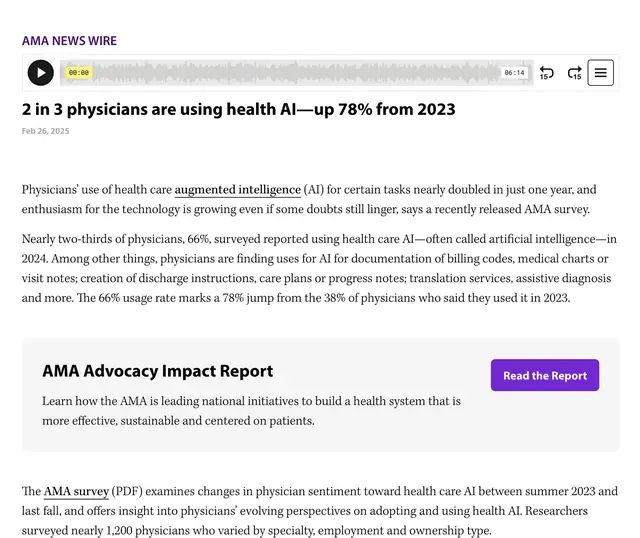
AI Agents in Healthcare: Intake, Booking and HIPAA Rules
Where AI agents do real work in a clinic today (calls, booking, reminders, intake), what HIPAA requires of the vendor, and six checks before going live.
Read the post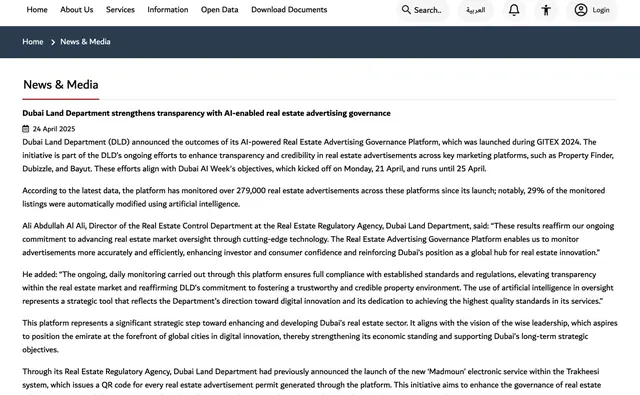
AI Agents in Real Estate: Lead Response, Viewings, Listings
Where AI agents help a brokerage today: answering leads, booking viewings and drafting listings, plus the consent, fair housing and Dubai permit rules.
Read the post
AI Agents in Financial Services: Onboarding, Support, Rules
Where AI agents work in financial services today (onboarding, document checks, client support), what FCA, ESMA, FINRA and the EU AI Act expect of them.
Read the post