
Brain chips and BCIs: what has happened and what is speculative
Brain chips are medical devices in early trials, not brain upgrades
Brain computer interfaces have moved from lab demos to early clinical trials, all of them in people with paralysis or ALS. Peer reviewed papers since 2023 show implants turning attempted speech into text at 62 words per minute, and Neuralink reports 21 people enrolled in its trials. None of these devices is approved for general use, and enhancing healthy people is not being tested at all.
That is a long way from the original version of this page, which promised cognitive enhancement, merged minds and a new era of human potential. None of that is supported by any trial result, so it is cut. What follows is what has happened, with the date and the paper or company page for each step, and then the claims that are still plans.
The decoding inside these devices is ordinary machine learning: a model trained to map patterns of neural activity to letters, words or cursor movements. If that part is unfamiliar, how a neural network learns explains the training loop, and the rest of the AI explained series covers the AI side in plain language.
If you are deciding where AI fits in your business today, a short call will separate what is ready now from what is still in trials. Book a call with GenovaFlow AI
A BCI records brain signals and a trained model decodes what the person intends
Every implanted BCI does two jobs. Electrodes record the activity of neurons, usually in the motor areas that would normally move the hand or the mouth, and software decodes that activity into an intended action. The 2023 Nature speech study, for example, trained a recurrent neural network on the participant's attempts to speak and combined its predicted speech sounds with a language model to find the most likely words.
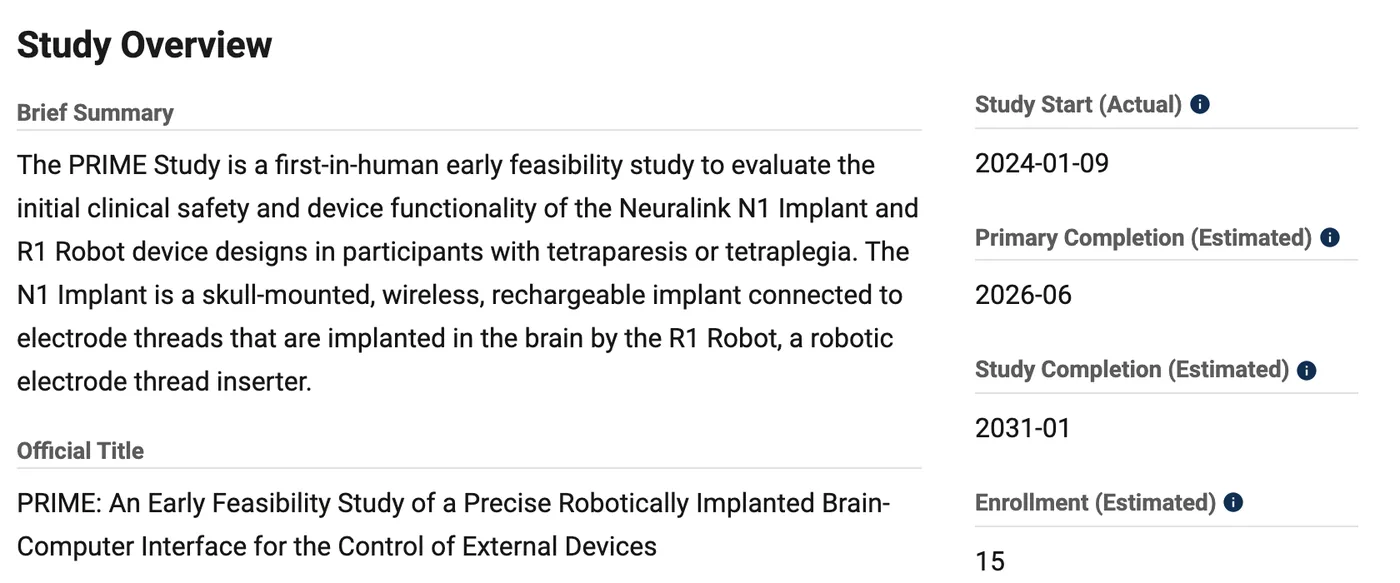
The companies differ mostly in where the electrodes go. Neuralink's N1 is, in the words of its trial registration, a skull mounted, wireless, rechargeable implant whose electrode threads are placed in the brain by a robot. Synchron's Stentrode sits inside a blood vessel in the brain, delivered like a stent, with no open brain surgery. Precision Neuroscience places a thin electrode film on the surface of the brain.
The trade off is between signal and risk. Electrodes inside brain tissue hear individual neurons clearly but need neurosurgery; a device in a blood vessel avoids opening the skull but records a weaker, blurrier signal. That is why the fastest speech results so far come from arrays placed in the cortex.
The peer reviewed results are about restoring speech
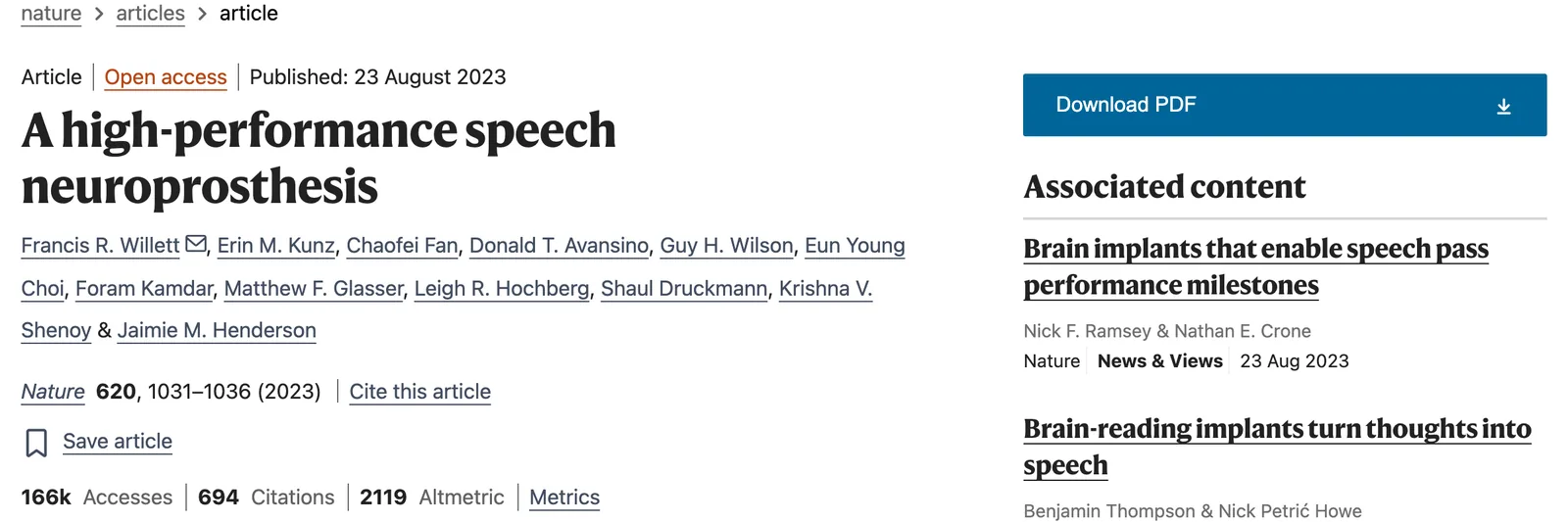
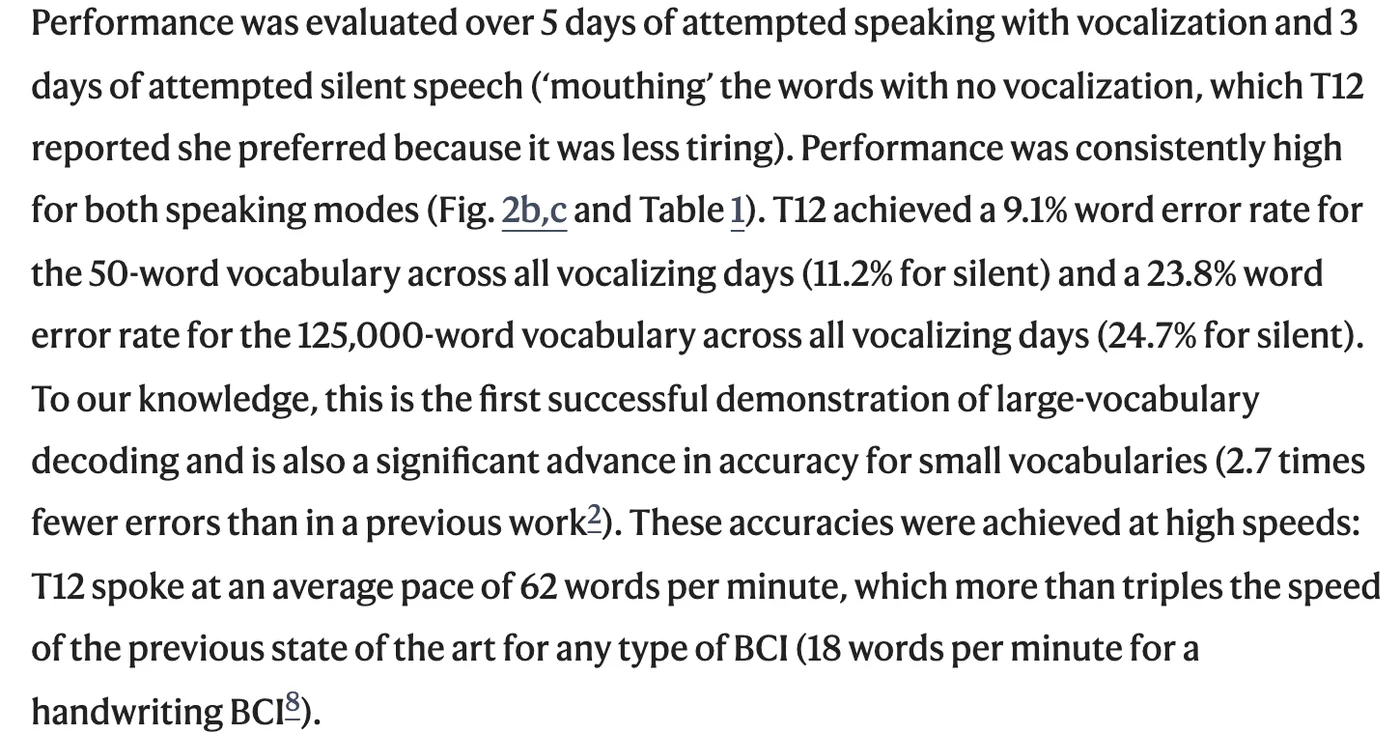
The strongest evidence is in journals, and it is about communication. On 23 August 2023 Nature published two speech studies on the same day. In the Stanford study led by Francis Willett, a participant's attempted speech was decoded at 62 words per minute, 3.4 times the previous record, with a 23.8 percent word error rate on a 125,000 word vocabulary. The authors note natural conversation runs at about 160 words per minute.
The second paper, from a UCSF team decoded text at a median of 78 words per minute with a median word error rate of 25 percent, and also produced speech audio in the participant's own pre injury voice and a talking facial avatar. These were single participants in research settings, which is the honest scale of the evidence.
Accuracy then improved sharply. A study of a man with ALS, published in the New England Journal of Medicine on 15 August 2024, reports that the implant sustained 97.5 percent accuracy in self paced conversations over more than 248 cumulative hours across 8.4 months. In June 2025 Nature described an implant that synthesises the participant's voice instantly from his brain activity, and in August 2025 a Cell paper on inner speech showed that imagined inner speech can also be decoded, along with ways to stop private thoughts being picked up by accident.
The company milestones, in order
The companies' milestones are regulatory steps and trial updates, reported on their own pages. Synchron's news page lists FDA Breakthrough Device designation for the Stentrode on 27 August 2020 and FDA approval of an investigational device exemption for human trials on 28 July 2021. On 30 September 2024 Synchron announced that all six patients in its US COMMAND study met the primary safety endpoint of no device related serious adverse events causing death or permanent increased disability; those results are the company's, not yet a journal paper. Synchron's own site still says its system is investigational and not approved for commercial use in any geography.
Neuralink received its investigational device exemption in May 2023 and reported its first human implant in January 2024. Its PRIME study is registered as an early feasibility study with an estimated enrollment of 15 and a start date of 9 January 2024. In a two year update on 28 January 2026, Neuralink reported 21 participants enrolled worldwide and typing speeds of up to 40 words per minute using imagined finger movements.
Two other dated steps matter. Apple announced in May 2025 that iOS, iPadOS and visionOS will add a protocol to support Switch Control for brain computer interfaces, which lets an implant drive a phone or tablet like any other accessibility input. And the FDA database shows a 510(k) clearance for Precision Neuroscience's Layer 7-T electrode with a decision date of 30 March 2025; the company says it covers implantation durations of up to 30 days, so it is a temporary device, not a permanent implant.
What is still a plan, a label or speculation
Several headline claims are goals, not results. Neuralink's January 2026 update says it aims for conversational speeds of 140 words per minute through a new trial called VOICE, and plans to increase its implant from 1,000 to 3,000 electrodes. The same post reports zero serious device related adverse events, which is the company's own statement rather than a peer reviewed finding.
Breakthrough Device designations are often read as approvals, and they are not. The FDA's own page describes the programme as a way to speed up development, assessment and review for devices that treat life threatening or irreversibly debilitating conditions. So Neuralink's designations for Blindsight in September 2024, a vision device, and for speech restoration in May 2025 mean the FDA will work with it more closely; neither is evidence that the device works in people.
The biggest speculation is the one the original post led with: chips that make healthy people smarter, faster or more creative. Every trial cited here enrols people with paralysis or severe speech loss, and none measures enhancement. Until a trial does, that idea belongs in forecasts, the same category as the predictions covered in where AI is heading.
Why this matters outside medicine
The technology that makes these implants useful is the same kind of model that turns speech into text on a phone call or a WhatsApp voice note. The hard part in both is accuracy on messy real input and a clear plan for when the model is unsure, which is the problem every working AI system has to solve.
For most businesses the useful AI is far less exotic: agents that answer, book and hand off to a person, built on large language models and grounded in your own data with retrieval augmented generation. The posts on AI agents for business show those systems in deployment, and the companion explainers on AI in robots and agentic AI separate evidence from claims in the same way this one does.
Questions people ask
How does Neuralink work?
Neuralink's N1 is a wireless, rechargeable implant mounted in the skull, with thin electrode threads placed in the brain by a surgical robot, as described in its PRIME trial registration. The threads record neuron activity in motor areas, and software decodes the intended movement, for example moving a cursor or typing, and sends it to a computer.
Is Neuralink safe?
It is still being tested for safety. The PRIME study is an early feasibility study whose first aim is initial clinical safety. Neuralink reported in January 2026 zero serious device related adverse events among its participants, but that is the company's own statement, not yet an independent peer reviewed safety result.
Can brain chips make you smarter?
There is no evidence that they can. Every published BCI trial so far, including the 2023 Nature speech study, enrols people with paralysis or severe speech loss and aims to restore movement or communication. No trial has tested whether an implant improves thinking in a healthy person.
Is Neuralink real?
Yes. Neuralink holds an FDA investigational device exemption from May 2023, implanted its first participant in January 2024 and reported 21 participants enrolled worldwide by January 2026. Its device is still investigational and is not approved for sale.
Sources
- A high performance speech neuroprosthesis, Willett et al., Nature 620, pages 1031 to 1036 (23 August 2023)
- A high performance neuroprosthesis for speech decoding and avatar control, Metzger et al., Nature (23 August 2023)
- An Accurate and Rapidly Calibrating Speech Neuroprosthesis, Card et al., New England Journal of Medicine (15 August 2024), PMC
- An instantaneous voice synthesis neuroprosthesis, Wairagkar et al., Nature (12 June 2025)
- Inner speech in motor cortex and implications for speech neuroprostheses, Kunz et al., Cell (14 August 2025), PMC
- PRIME study, NCT06429735, ClinicalTrials.gov
- VOICE study, NCT07224256, ClinicalTrials.gov
- COMMAND study, NCT05035823, ClinicalTrials.gov
- Neuralink's first clinical trial in humans is open for recruitment, Neuralink (19 September 2023)
- PRIME Study Progress Update, Neuralink (12 April 2024)
- Two Years of Telepathy, Neuralink (28 January 2026)
- Neuralink Receives Breakthrough Device Designation for Blindsight (17 September 2024)
- Neuralink Receives Breakthrough Device Designation for Speech (1 May 2025)
- News, Synchron
- Technology, Synchron
- Synchron Announces Positive Results from U.S. COMMAND Study (30 September 2024), press release
- Apple unveils powerful accessibility features coming later this year, Apple Newsroom (May 2025)
- 510(k) K242618, Layer 7-T, Precision Neuroscience, FDA database
- Precision Neuroscience receives FDA clearance for high resolution cortical electrode array, press release
- Breakthrough Devices Program, U.S. Food and Drug Administration
Keep reading
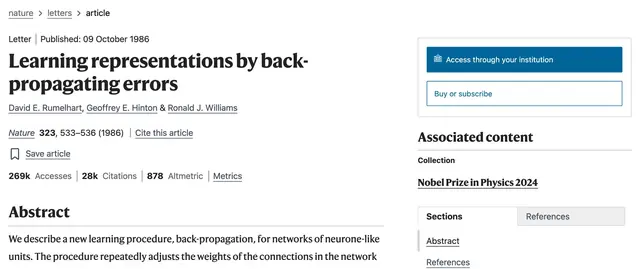
How a neural network learns, from weights to backpropagation
A neural network learns by measuring its error and adjusting its weights with gradient descent and backpropagation. The layers, the loss and the 1986 method.
Read the post
Where AI is heading: what the data shows and what is forecast
Where AI is heading, from dated reports: Stanford's AI Index, Epoch AI, METR and the IEA. What has been measured, what is forecast, and who said it.
Read the post
AI in robots: what is deployed today and what is still a demo
What AI robots actually do today, from IFR counts, Amazon, Waymo and dated humanoid pilots, which claims have evidence, and the limits the industry names.
Read the post