
AI in robots: what is deployed today and what is still a demo
Most AI robots at work today are in factories, warehouses and cars
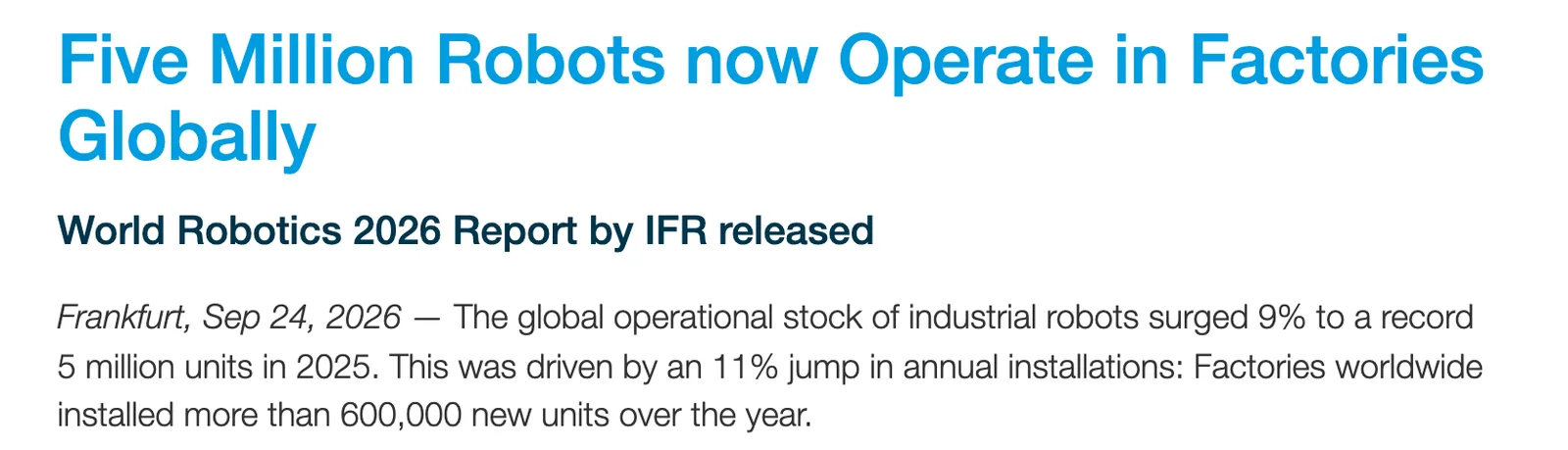
AI robots that do real work today are mostly industrial arms, warehouse machines and driverless cars, not humanoids. The International Federation of Robotics counted a record 5 million industrial robots operating in factories in 2025, while it puts humanoid sales that year at about 7,000 units, most of them in specialised roles that often still need a person steering them remotely.
That gap between what is counted and what is demonstrated is the whole story of this topic. This post sorts the evidence into what is deployed and measured, what companies report about their own pilots, and what is still a claim, with the date and the source for each. The original version of this page described a robot revolution; this one cuts every claim that no source could back.
The software side of this follows the same pattern as the rest of AI, which the AI explained posts walk through: how a neural network learns, what agentic AI means, and what the data says about where AI is heading.
If you are deciding where AI fits in your business today, a short call will separate the narrow jobs it handles well from the demos. Book a call with GenovaFlow AI
Factory and warehouse robots are counted in millions
The IFR's World Robotics 2026 report, released on 24 September 2026, says factories installed more than 600,000 new industrial robots in 2025, an 11 percent rise, taking the operating stock up 9 percent to 5 million. China installed 354,000 of them, 59 percent of the world total.
Density shows how unevenly this is spread. In an April 2026 release using 2024 data, the IFR puts the Republic of Korea at 1,220 robots per 10,000 employees against a global average of 132. Outside factories, the IFR's service robot release of 30 September 2026 reports that shipments of professional service robots rose 24 percent to almost 250,000 units in 2025, led by transport and logistics robots at 117,500 units.
Warehouses are where AI and robots meet at the largest scale. Amazon announced on 1 July 2025 that it had deployed its one millionth robot across a network of more than 300 facilities, and introduced DeepFleet, a model it says will coordinate how the fleet moves; the robots are counted, the coordination gains are a company claim. Its touch sensing picker, Vulcan, announced on 7 May 2025, can pick and stow approximately 75 percent of the item types Amazon stores and asks a human partner to tag in when it cannot handle one.
Driverless cars are the clearest case of AI making decisions in public
A car with nobody in the driving seat is a robot making every decision in an uncontrolled environment, which makes it a useful benchmark for the rest of the field. Waymo's safety impact dashboard reports that through June 2026 it had driven 271.3 million rider only miles without a human driver.
The same page compares Waymo's crash rates with human driving benchmarks in the cities where it operates. Those comparisons are Waymo's own analysis, published on its own site, so they belong in the measured but self reported category: real data, collected and framed by the company that benefits from it.
Humanoid robots: a few dated deployments and a lot of demos
Humanoid claims are easy to make and hard to check, so it helps to look for a named site, a date and a task. Logistics company GXO announced on 27 June 2024 a multi year agreement with Agility Robotics, calling it the industry's first formal commercial deployment of humanoid robots, with Digit moving totes from collaborative robots onto conveyors after a pilot in late 2023.
Figure reported on 19 November 2025 on an 11 month Figure 02 deployment at BMW's Spartanburg plant: 10 hour shifts Monday to Friday, more than 90,000 parts loaded and a contribution to the production of more than 30,000 X3 vehicles. It also named the robot's forearm as its top hardware failure point there. The report does not say how many robots were used, and the numbers come from Figure, not from BMW.
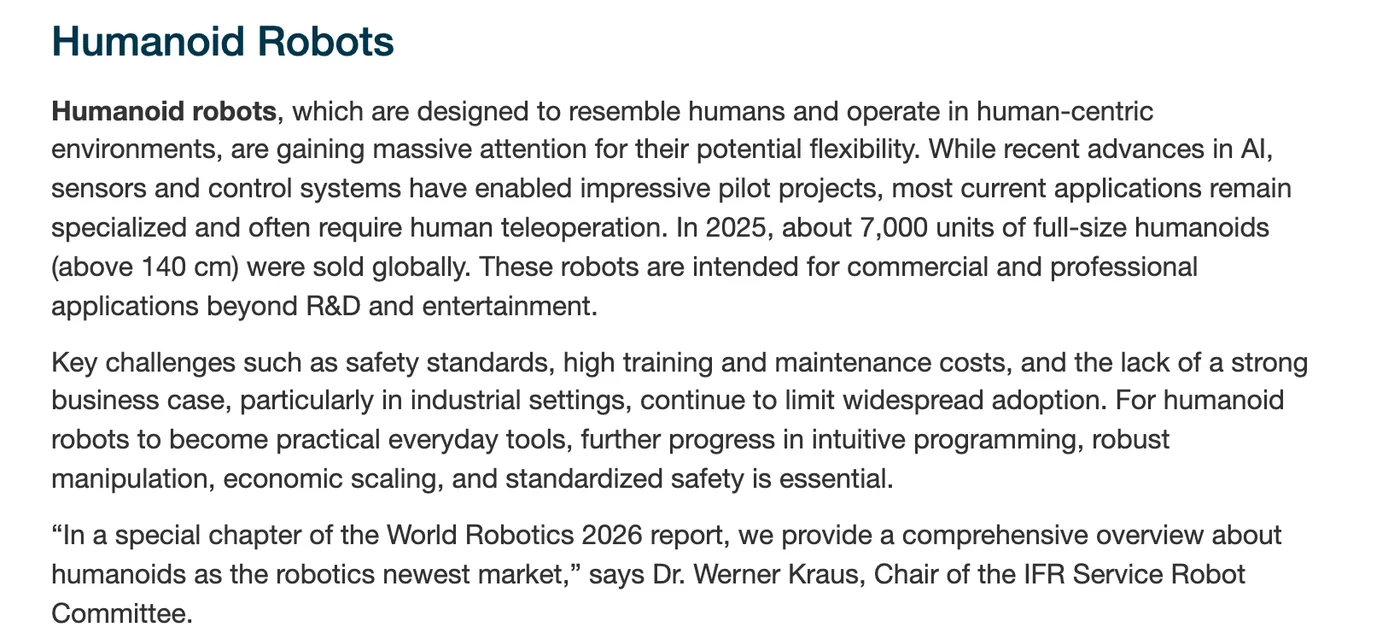
The IFR's view of the whole category is cautious. In its September 2026 service robot release, it says that while advances in AI, sensors and control have enabled impressive pilot projects, most current humanoid applications remain specialised and often require human teleoperation, and that about 7,000 full size humanoids were sold in 2025.
Robot foundation models are improving, and their makers publish the gaps
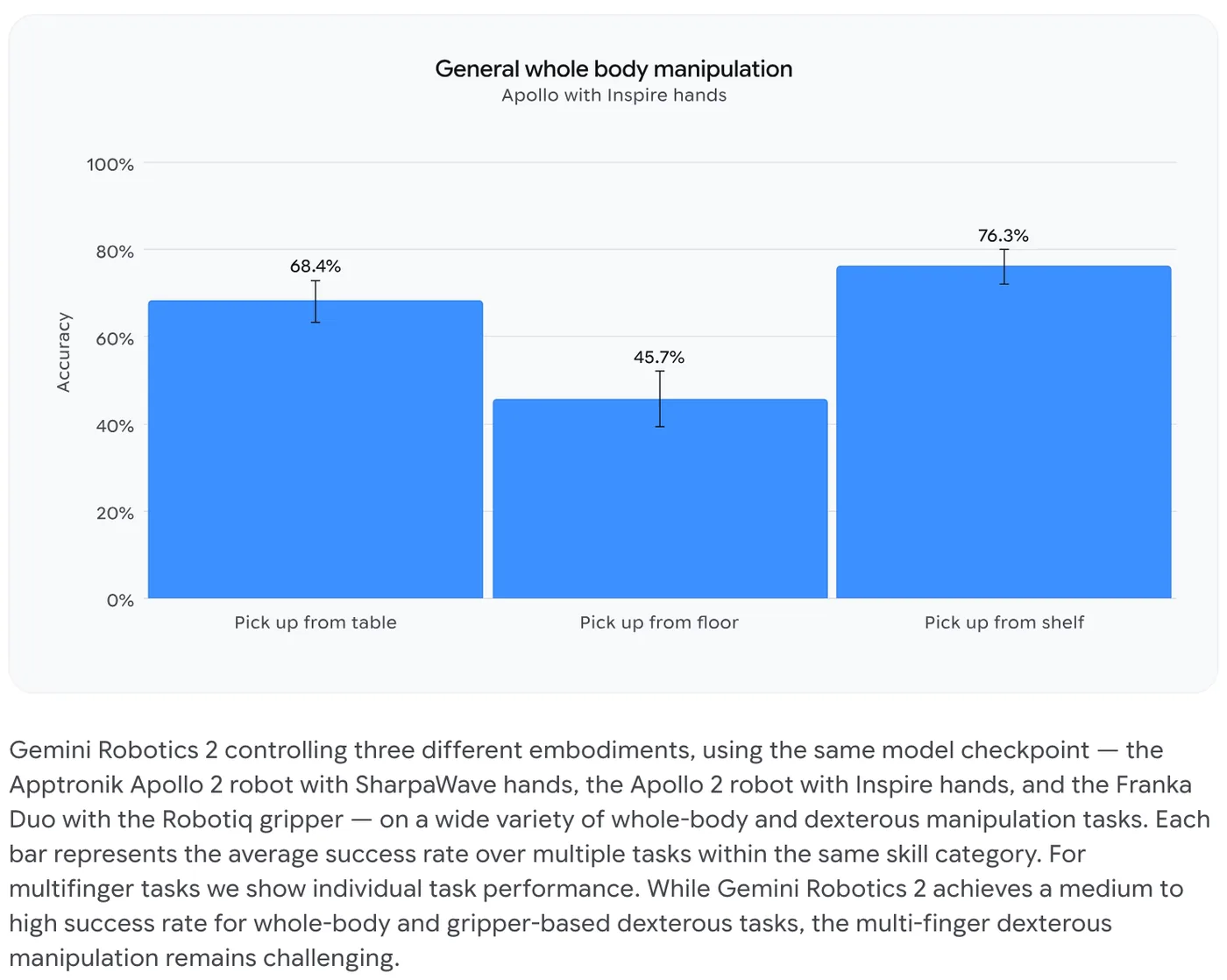
The newest step is a single AI model that controls many robot bodies, trained the way language models are, which is why the same labs show up in both fields. Google DeepMind's Gemini Robotics 2, published on 30 July 2026, controls robots including Apptronik's Apollo 2 humanoid. Its own chart puts average success at 68.4 percent for picking objects up from a table, 45.7 percent from the floor and 76.3 percent from a shelf, and the caption says that multi finger dexterous manipulation remains challenging.
Physical Intelligence makes a similar point about its own model. Its π0.5 post of 22 April 2025 shows the robot tidying kitchens and bedrooms in homes that were not in its training data, and says plainly that the model is far from perfect and does not always succeed on the first try.
The independent numbers are lower than the demos suggest. Stanford's 2026 AI Index reports that robots succeed in only 12 percent of real household tasks, while robotic manipulation in simulation has reached 89.4 percent on RLBench. A lab or a simulator is predictable; a kitchen is not.
The limits: reliability, cost, safety rules and a business case
The limits are written down by the industry itself. The IFR's position paper on humanoids of 14 August 2025 says it remains uncertain if and when mass adoption of humanoids will take place, and that adoption as universal household helpers may not happen in the near or medium term. Its September 2026 release names the obstacles: safety standards, high training and maintenance costs, and the lack of a strong business case, particularly in industrial settings.
Safety rules are moving too. The revised ISO 10218 standard for industrial robot safety, announced by the Association for Advancing Automation on 17 February 2025, folds in collaborative robot rules and adds cybersecurity requirements, which matters as more robots take instructions from networked AI models. A robot that works in a demo still has to pass these rules before it shares a floor with people.
So the honest summary is that AI already runs inside millions of robots doing narrow, repeated jobs, that general purpose humanoids exist in pilots with published numbers, and that household robots remain a forecast. The robots that work best today do one task in a controlled space, with a person ready to step in.
What this means if you run a business
Most companies will meet AI through software long before they meet it in a robot. The same rule applies to both: deploy it where the task is narrow and the environment is predictable, measure it against how a person does the job, and design the handoff for when it fails. Vulcan asking a human to tag in is a good model of that design.
That is also where AI agents for customer calls, bookings and back office work are today. The posts on AI agents for business cover those deployments with costs and handoff rules, and the explainers on how large language models differ, retrieval augmented generation and brain computer interfaces apply the same evidence first approach to other parts of AI.
Questions people ask
How many robots are there in the world?
For industrial robots, the International Federation of Robotics counted a record 5 million in operation in factories in 2025, after more than 600,000 were installed that year. Service robots are counted separately; professional service robot shipments reached almost 250,000 units in 2025. Household gadgets such as robot vacuums are not in the industrial figure.
Are humanoid robots real?
Yes, and some are in paid work, but only a few deployments come with dated, published numbers, such as Agility's Digit at GXO and Figure's report from BMW's Spartanburg plant. The IFR says most current applications remain specialised and often require human teleoperation, with about 7,000 full size humanoids sold in 2025.
Are humanoid robots ready to be deployed?
For narrow, repeated tasks at a single site, a few are, under pilot or service agreements. For general work or homes, not yet: Stanford's 2026 AI Index reports robots succeed in only 12 percent of real household tasks, and the IFR says mass adoption as household helpers may not happen in the near or medium term.
How many robots does Amazon have?
Amazon said on 1 July 2025 that it had deployed its one millionth robot, across a network of more than 300 facilities worldwide. It has not published a more recent total on that page, so treat one million as the figure as of mid 2025.
Sources
- Five Million Robots now Operate in Factories Globally, International Federation of Robotics (24 September 2026)
- Global sales of professional service robots surge 24 percent, International Federation of Robotics (30 September 2026)
- Robot density surges in Europe, Asia and Americas, International Federation of Robotics (8 April 2026)
- Humanoid Robots: Vision and Reality paper published by IFR (14 August 2025)
- Amazon launches a new AI foundation model to power its robotic fleet and deploys its 1 millionth robot, Amazon (1 July 2025)
- Introducing Vulcan: Amazon's first robot with a sense of touch, Amazon (7 May 2025)
- Waymo safety impact data hub, Waymo
- GXO signs an industry first, multiyear agreement with Agility Robotics, GXO (27 June 2024)
- F.02 Contributed to the Production of 30,000 Cars at BMW, Figure (19 November 2025)
- Gemini Robotics 2 brings whole body intelligence to robots, Google DeepMind (30 July 2026)
- pi0.5: a VLA with open world generalization, Physical Intelligence (22 April 2025)
- 2026 AI Index, Chapter 2: Technical Performance, Stanford HAI
- Updated ISO 10218: major advancements in industrial robot safety standards, A3 (17 February 2025)
Keep reading
Where AI is heading: what the data shows and what is forecast
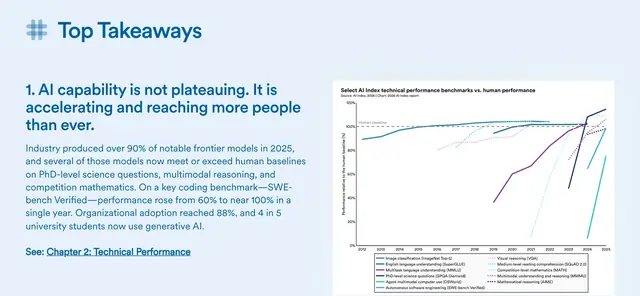
Where AI is heading, from dated reports: Stanford's AI Index, Epoch AI, METR and the IEA. What has been measured, what is forecast, and who said it.
Read the post
What agentic AI is and how it differs from a chatbot
Agentic AI is a model that picks its own next step and uses tools in a loop. How it differs from a chatbot or a workflow, with a worked example.
Read the post
Brain chips and BCIs: what has happened and what is speculative
Brain computer interfaces today: peer reviewed speech results, Neuralink and Synchron trial milestones with dates, and the claims that are still plans.
Read the post