
Where AI is heading: what the data shows and what is forecast
The measured trends are steep, and everything past today is a forecast
Where AI is heading can be answered in two parts. The measured part is steep: training compute for frontier language models has grown about 5x a year since 2020, and the length of task an AI agent can finish has doubled roughly every 7 months, according to METR. The rest is forecast, and the forecasts mostly disagree on timing, not direction.
This post keeps the two apart. Every number below links to the report that published it, with the date it was published, and each section says whether it is reporting something that already happened or a projection. The original version of this page described a world of infinite possibilities; this one sticks to what the reports can support and cuts what they cannot.
If the mechanics are new to you, start with how a neural network learns and how large language models differ, which explain what is being scaled when these reports talk about compute and parameters.
If you are deciding where AI fits in your business today, a short call will separate what is ready from what is still a forecast. Book a call with GenovaFlow AI
What has already happened, according to the 2026 AI Index
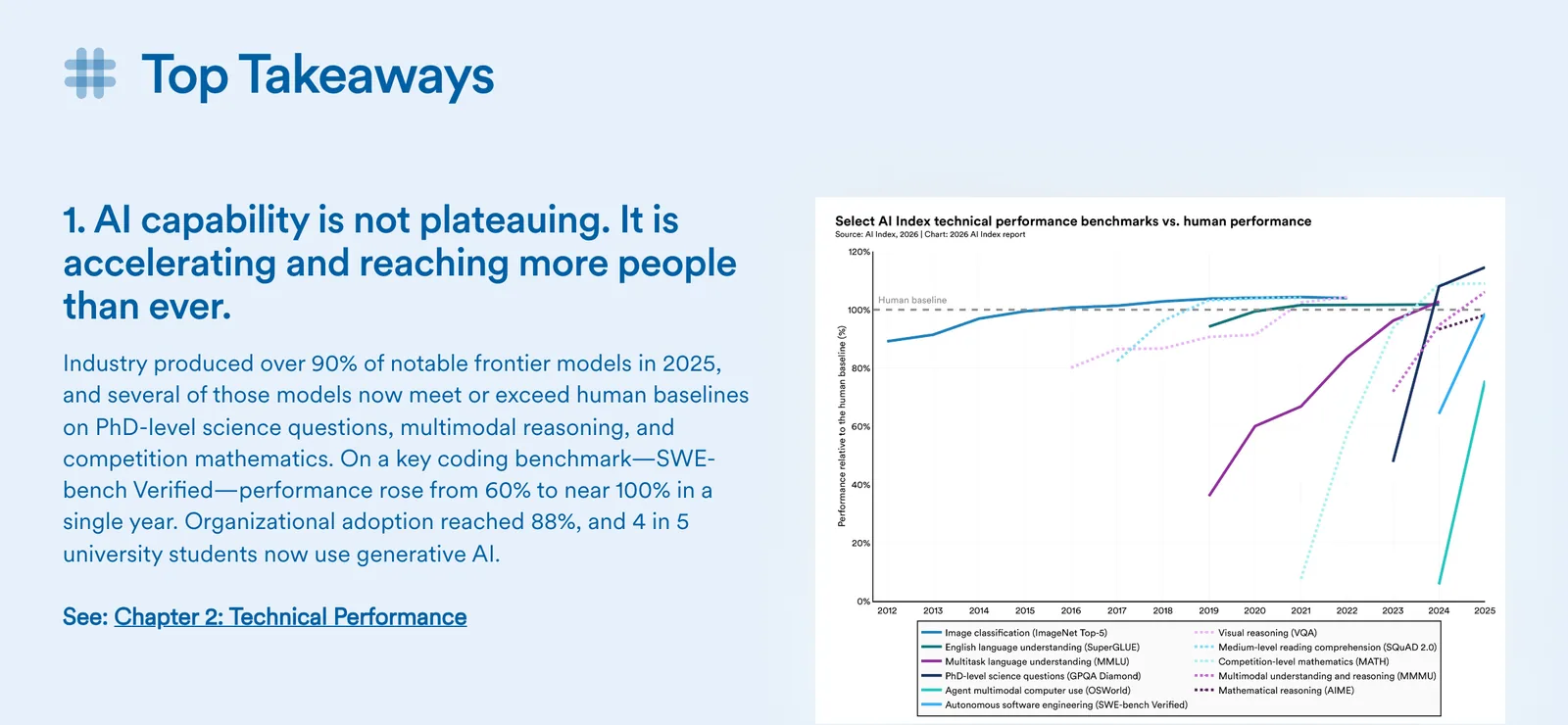
Stanford HAI's 2026 AI Index, published in April 2026, is the broadest annual measurement of the field, and its headline is that capability has not levelled off. On its summary page, industry produced over 90 percent of notable frontier models in 2025, performance on a key coding benchmark rose from 60 percent to near 100 percent in a single year, and organisational adoption reached 88 percent.
The research and development chapter fills in the physical side. It reports that the United States produced 59 notable models in 2025 to China's 35, that global AI compute capacity grew 3.3x a year since 2022 to 17.1 million H100 equivalents, and that AI data centre power capacity rose to 29.6 GW.
Adoption by people moved just as quickly. The economy chapter reports that generative AI reached 53 percent adoption in three years, faster than the personal computer or the internet, and the summary page puts the United Arab Emirates at 64 percent. The same chapter adds a detail that matters for anyone planning around agents: AI agent deployment was in the single digits across nearly all business functions.
That gap between what models score and what companies run is the most useful thing in the report. The technical performance chapter describes a jagged frontier: on OSWorld, a test of agents doing real computer tasks, accuracy rose from roughly 12 percent to 66.3 percent, yet agents still fail roughly one attempt in three on structured benchmarks, and documented AI incidents rose to 362 from 233 in 2024 according to the same summary.
Compute and training cost keep rising while the price of a given result falls
Epoch AI tracks the inputs. Its trends dashboard, last updated in February 2026, reports that training compute for frontier language models has grown about 5x a year since 2020, and that the cost of training them has risen about 3.5x a year over the same period. Those are measurements of past runs, fitted to a trend line.
The price of using a model moves the other way. In a March 2025 analysis, Epoch found that the price of reaching GPT-4's level on a set of PhD level science questions fell by 40x a year, with declines ranging from 9x to 900x a year depending on the milestone. Epoch adds its own caveat: the fastest drops happened in the most recent year, so it is less clear they will persist.
Put together, the measured picture is that the biggest models cost more to build every year while yesterday's frontier gets cheap quickly. For a business that is the practical point: a capability that was too expensive to run on every customer message a year ago may not be now.
AI agents are finishing longer tasks, and the doubling time has shortened
METR, an independent research group, measures how long a task an AI model can complete, timed by how long the same task takes a skilled person. Its original study, published on 19 March 2025, found that this time horizon had been doubling about every 7 months for six years, and that models almost always succeed at tasks that take people under 4 minutes but rarely at tasks over about 4 hours.
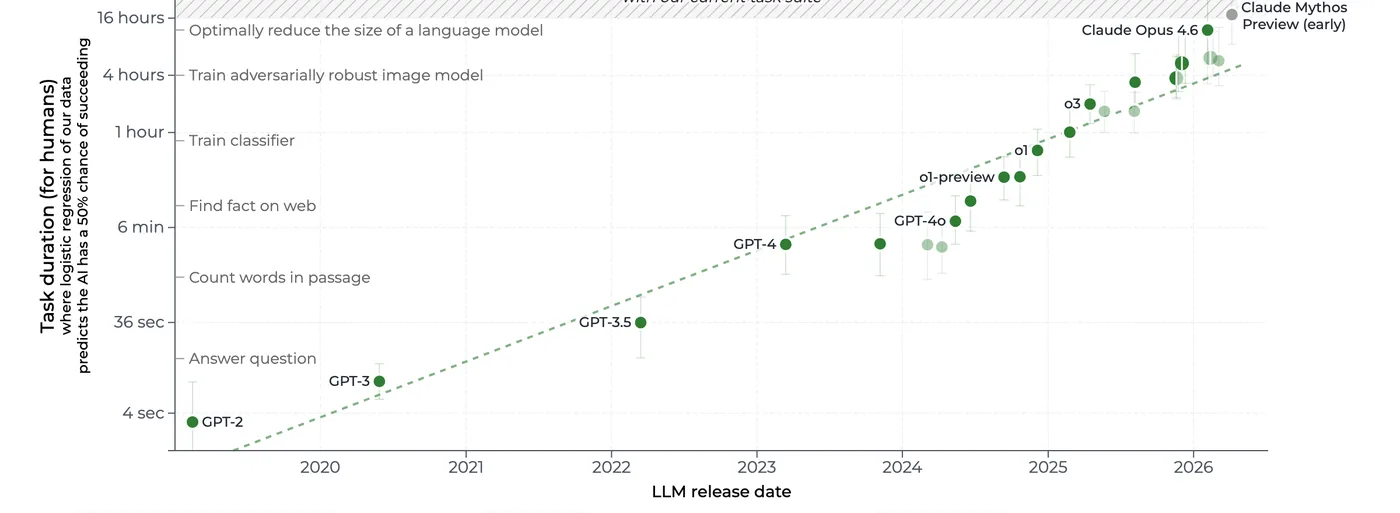
The newer measurements are faster. In an update published on 29 January 2026, METR put the doubling time since 2024 at 109 days on its original task set and 89 days on the updated one. Its May 2026 frontier risk report gives the public frontier, as of February and March 2026, a time horizon of about 12 hours at 50 percent success, with a wide uncertainty range of 5 to 61 hours.
Read the chart carefully. The points are data; the dashed line is a fit, and 50 percent success means the agent fails on half of tasks that long. METR itself warns that its estimates depend on which tasks and which human baselines it chose. This is the trend most often extrapolated into predictions about agents, which is why it helps to know what agentic AI actually means before you plan around one.
The forecasts, each with who made it and when
Everything in this section is a projection. Epoch AI's August 2024 report Can AI scaling continue through 2030? concluded that training runs of 2e29 FLOP will likely be feasible by the end of the decade, and that the constraint likely to bind first is power, followed by the capacity to manufacture enough chips.
Data is the second limit people forecast. Epoch's paper on training data, dated June 2024, estimates that if current trends continue, language models will fully use the stock of public human text between 2026 and 2032. That forecast is now inside its own window, and it is one reason labs talk more about synthetic data and learning from use.
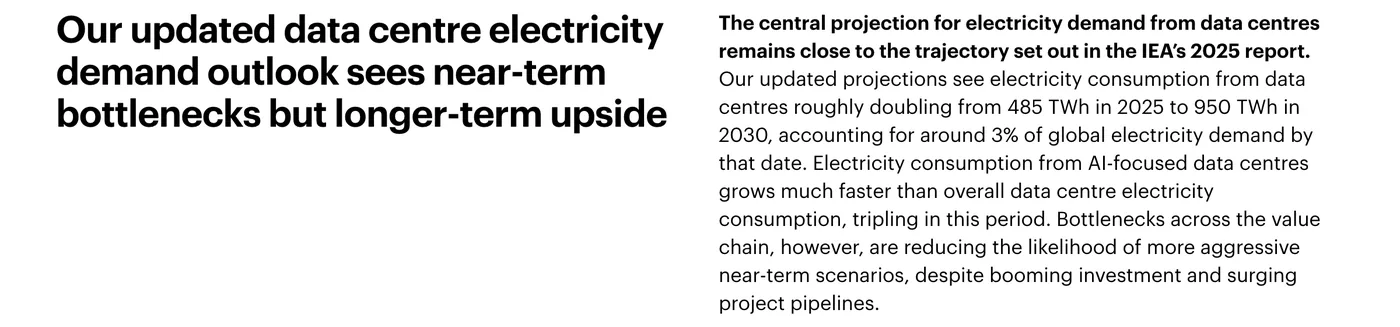
Power is the forecast with the most official backing. In Key Questions on Energy and AI published on 16 April 2026, the International Energy Agency reports as data that data centre electricity demand grew 17 percent in 2025, and projects that it will roughly double from 485 TWh in 2025 to 950 TWh in 2030, around 3 percent of global electricity demand.
The labs publish timing forecasts too, and they are the least certain of all because they come from the companies building the systems. In its recommendations to the US government on 6 March 2025, Anthropic wrote that it expects powerful AI systems to emerge in late 2026 or early 2027, and listed what it means by that, starting with intellectual capabilities matching or exceeding Nobel Prize winners across most disciplines. Google DeepMind wrote on 2 April 2025 that AGI, AI at least as capable as humans at most cognitive tasks, could be here within the coming years. Neither is a measurement, and both should be checked against the measured trends above as dates arrive.
Plan around what is measured today, and treat dates as hypotheses
For a company deciding where AI fits, the measured trends give a clear instruction and the forecasts give a weak one. The data says models are getting more capable and cheaper per result every year, and that agents can now handle tasks of hours, not seconds. It also says agents still fail often on structured work and that very few businesses run them across their functions yet, which is where most of the practical gains still sit.
So the sensible plan uses today's capability for narrow, checked jobs, such as answering from your own documents with retrieval augmented generation or handing a well defined process to an agent with a person in the loop, and revisits the plan as the measurements move. The posts on AI agents for business look at what that looks like in deployed systems, and the companion explainers on AI in robots and brain computer interfaces apply the same rule of separating evidence from forecast.
The reports above publish new editions every year, and some update monthly. When a forecast's date arrives, compare it with the next measurement rather than the next announcement. The rest of the AI explained series covers the underlying ideas.
Questions people ask
What will AI be like in 2030?
Nobody has measured 2030, so every answer is a forecast. The best documented ones are about inputs: Epoch AI projects that training runs of 2e29 FLOP will likely be feasible by 2030, with power as the first constraint, and the IEA projects data centre electricity use roughly doubling to 950 TWh by 2030. What those inputs will be able to do is far less certain.
What will AI be like in 10 years?
There is no measured basis for a ten year answer. The closest thing is an extrapolation: METR found the length of tasks AI agents complete doubling about every 7 months and noted that if the trend held to the end of the decade, systems could carry out month long projects. METR itself flags that the trend may change and that its estimates depend on the tasks chosen.
Is AI going to take over jobs?
The reports cited here measure adoption, not job losses. Stanford's 2026 AI Index records organisational adoption of 88 percent but finds AI agent deployment in the single digits across nearly all business functions, so most companies use AI to assist people rather than to run whole roles. How that changes is a forecast, and the data does not settle it yet.
Sources
- The 2026 AI Index Report, Stanford HAI
- 2026 AI Index, Chapter 1: Research and Development, Stanford HAI
- 2026 AI Index, Chapter 2: Technical Performance, Stanford HAI
- 2026 AI Index, Chapter 4: Economy, Stanford HAI
- Trends in Artificial Intelligence, Epoch AI (updated February 2026)
- LLM inference prices have fallen rapidly but unequally across tasks, Epoch AI (March 2025)
- Can AI scaling continue through 2030?, Epoch AI (August 2024)
- Will we run out of data? Limits of LLM scaling based on human generated data, Epoch AI (June 2024)
- Measuring AI Ability to Complete Long Tasks, METR (19 March 2025)
- Time Horizon 1.1, METR (29 January 2026)
- Frontier Risk Report, METR (19 May 2026)
- Key Questions on Energy and AI, executive summary, International Energy Agency (16 April 2026)
- Anthropic's recommendations to OSTP for the U.S. AI Action Plan, Anthropic (6 March 2025)
- Taking a responsible path to AGI, Google DeepMind (2 April 2025)
Keep reading
What agentic AI is and how it differs from a chatbot
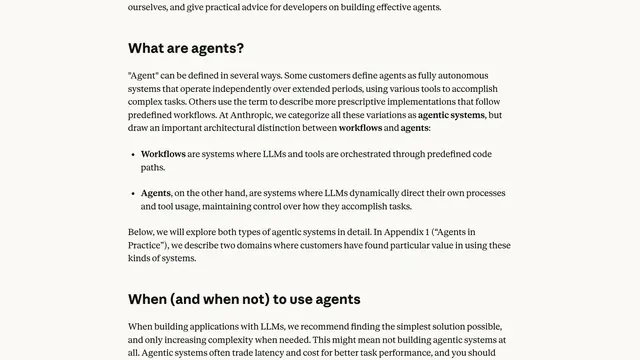
Agentic AI is a model that picks its own next step and uses tools in a loop. How it differs from a chatbot or a workflow, with a worked example.
Read the post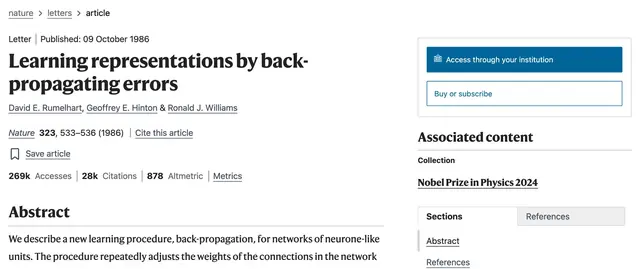
How a neural network learns, from weights to backpropagation
A neural network learns by measuring its error and adjusting its weights with gradient descent and backpropagation. The layers, the loss and the 1986 method.
Read the post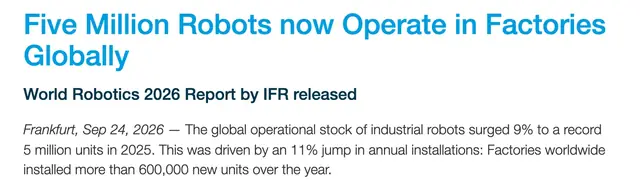
AI in robots: what is deployed today and what is still a demo
What AI robots actually do today, from IFR counts, Amazon, Waymo and dated humanoid pilots, which claims have evidence, and the limits the industry names.
Read the post