
How much does an AI agent cost to build and run?
Running an agent costs cents a conversation, building it costs more
Running an AI agent usually costs between a fraction of a cent and about ten cents per conversation in model fees, plus a fixed platform fee and whatever the channel charges. In the worked example below, a WhatsApp support agent handling 1,000 conversations a month comes to about $86 plus €50 a month on Claude Sonnet 5.5, priced from Anthropic's pricing page. Building it is the larger cost, and nobody publishes a price for that.
The bill has five parts: the model, priced per million tokens; the platform that runs the workflow, priced per execution or free if you host it; the channel, priced per message or per minute; a knowledge base, often free at small sizes; and the build and upkeep, which is labour and where most of the money goes. Each part is below with its price from the vendor's own page, checked on 23 October 2026, then one example with the arithmetic shown.
If you have a quote for an agent and cannot tell what the monthly bill will be, we can work it out with your own numbers. Book a call with GenovaFlow AI
The model is priced per token, and your choice moves it twentyfold
Model providers charge per million tokens, with input (what you send) and output (what the model writes) priced separately. A token is a small chunk of text; Anthropic's glossary puts it at about 3.5 English characters on its earlier models, with newer models producing about 30 percent more tokens for the same text.
The spread between models is the first thing that decides the bill. On Anthropic's price list, Claude Haiku 5.5 costs $0.10 per million input tokens and $0.50 per million output tokens, Claude Sonnet 5.5 costs $2 and $10, and Claude Opus 5.5 costs $4 and $20. Sonnet 5.5 is exactly twenty times the price of Haiku 5.5 on both sides, so the same agent on the same traffic costs twenty times more on one than the other.
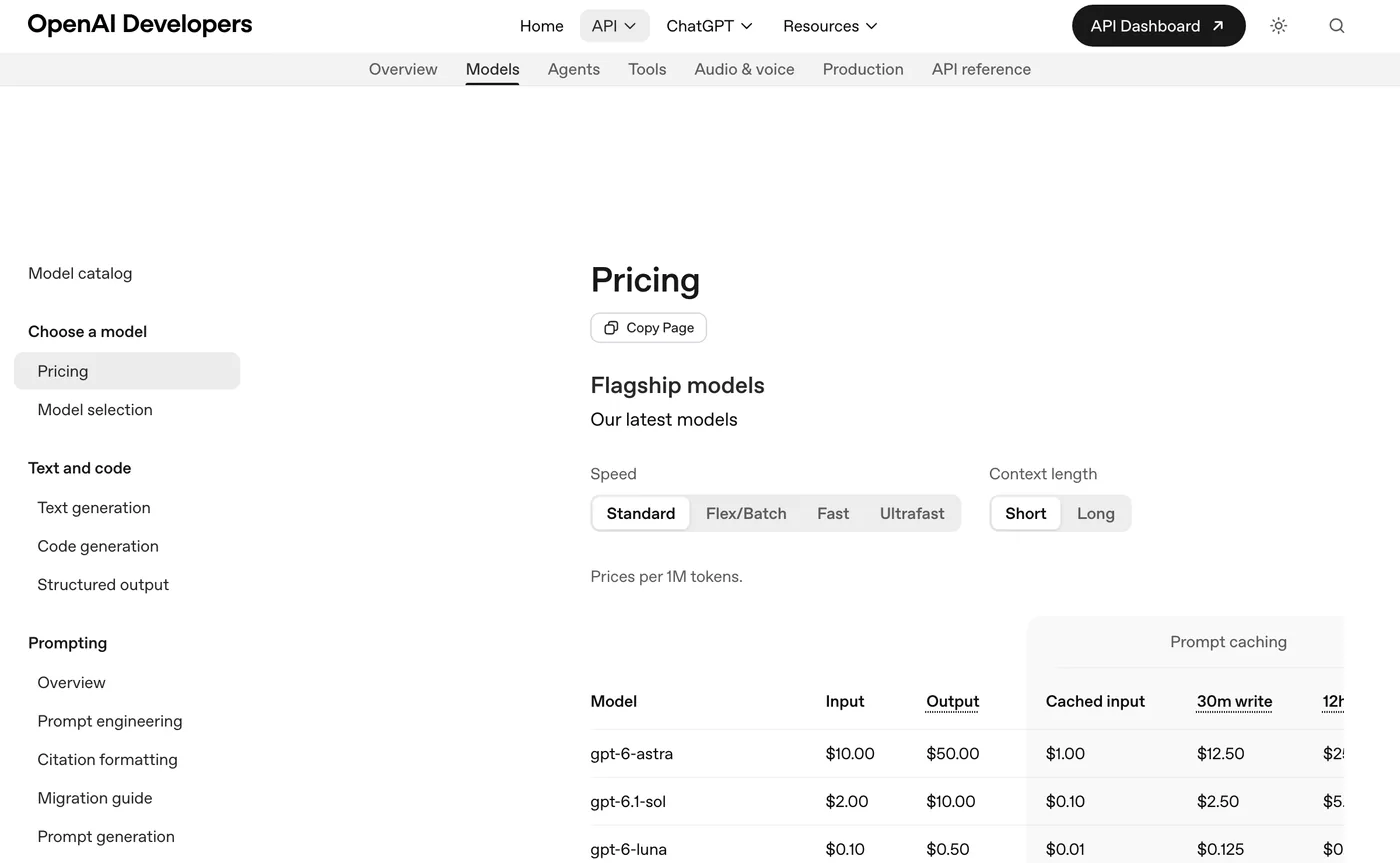
OpenAI's tiers look similar. Its pricing page lists gpt-6-luna at $0.10 input and $0.50 output, gpt-6.1-sol at $2.00 and $10.00, and gpt-6-astra at $10.00 and $50.00. Google's Gemini API pricing shows Gemini 4 Argon at $2.00 input and $10.00 output through 30 November 2026, rising to $4.00 and $20.00 from 1 December 2026, which is a good reason to date every price you put in a budget. For how these models differ beyond price, see how large language models differ.
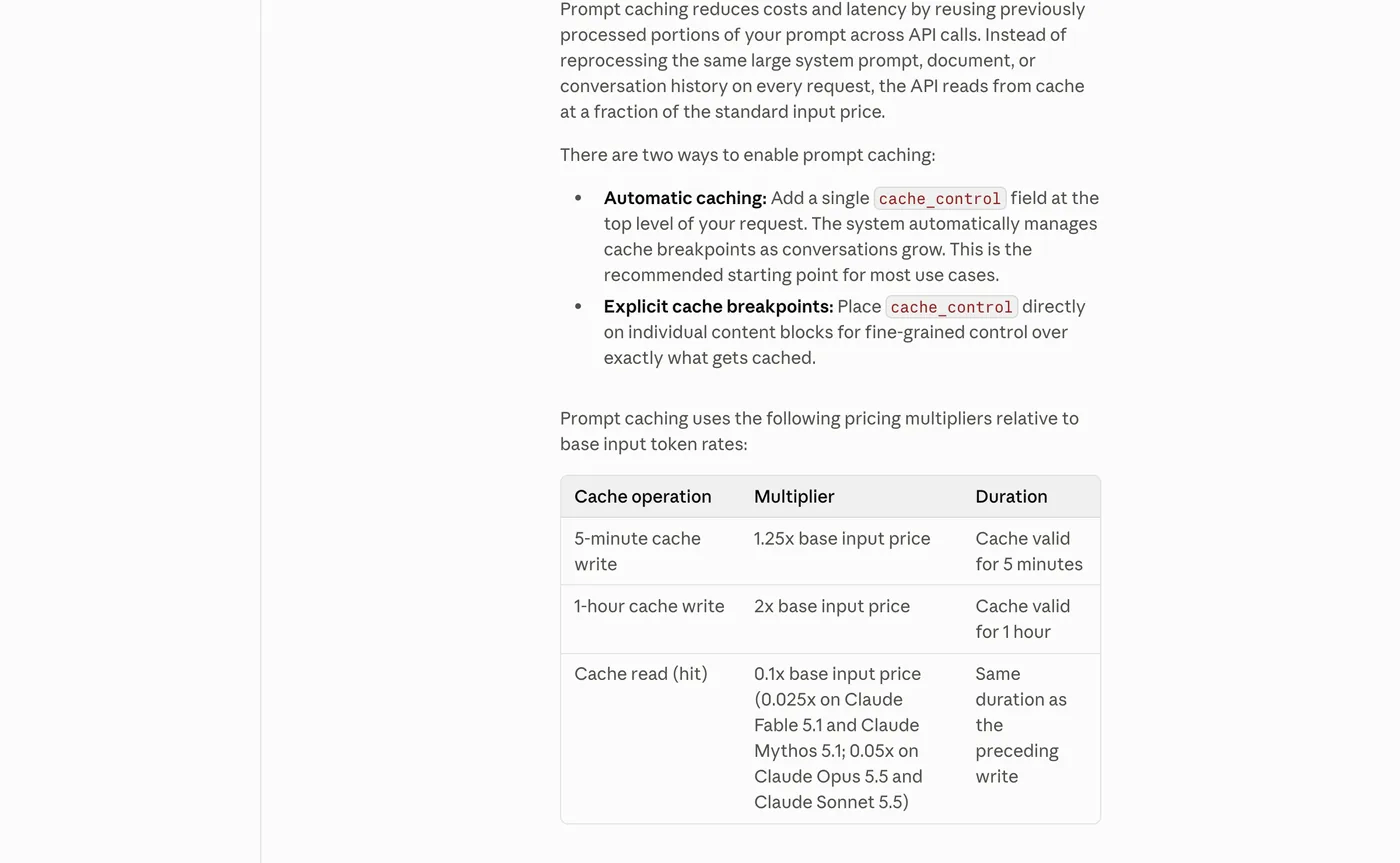
Two discounts change these numbers. Prompt caching stores the part of a prompt that repeats, such as the instructions, and reads it back cheaply on later calls. Anthropic's caching table prices a five minute cache write at 1.25 times the base input price and a cache read at 0.1 times, or 0.05 times on Opus 5.5 and Sonnet 5.5. Batch processing, for work that does not need an answer straight away, takes 50 percent off both input and output on the same page, and Google lists the same 50 percent cut for its Batch API.
The platform charges per run, or nothing if you host it
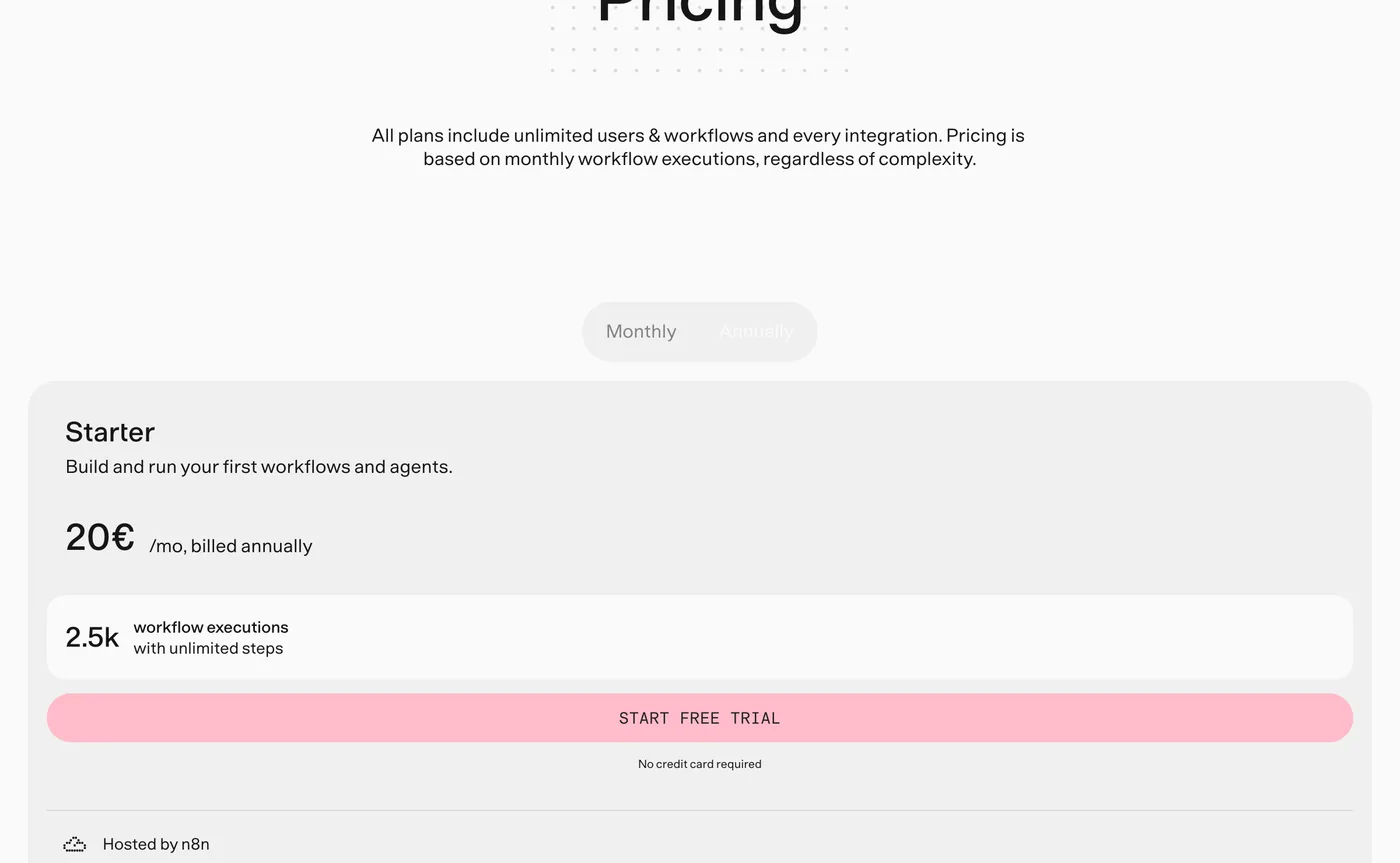
Something has to receive the message, call the model, run the tools and send the reply. In n8n that is a workflow, and n8n's pricing page bills by execution: "a single run of your entire workflow", whatever its number of steps. Starter is €20 a month billed annually for 2,500 executions, and Pro is €50 a month billed annually for 10,000.
The other route costs nothing in licence fees. n8n's hosting docs say that without a licence key n8n runs as the free Community edition, so you pay only for the server and the time to look after it. Our guide to self hosting n8n on the Google Cloud free tier walks through that setup and the one charge the free tier does not cover. Either way, count executions carefully: a workflow started by a webhook runs once for every event that reaches it.
WhatsApp charges per delivered message, voice charges per minute
The channel is a bill of its own, separate from the AI. Meta's WhatsApp pricing docs charge per delivered message sent by the business, and from 1 October 2026 that again includes service messages, the free form replies inside the 24 hour window after a customer writes. Each business phone number gets 1,000 delivered service messages free a month, and unused ones do not roll over.
Above that allowance, the price depends on the customer's country. Meta's page on non template messages says service messages cost the same as utility and authentication messages in each market, and the one rate it prints in full is Brazil's utility and authentication rate as of 1 July 2026, 0.68 US cents per message, which the example below uses as its service rate. Rates for other countries are in Meta's rate cards, which Meta may update up to quarterly. How the 24 hour window shapes an agent's replies is covered in multilingual WhatsApp agents and after hours bookings.
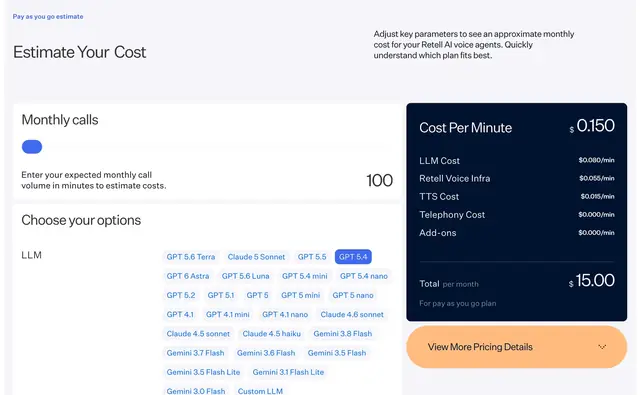
Voice is priced by the minute and stacks several vendors. Retell AI's pricing page lists its voice infrastructure at $0.055 a minute, its standard voices at $0.015, GPT 5.4 mini at $0.024 and telephony from $0.015, which adds up to $0.109 a minute before the $2 monthly phone number. The full comparison with a person on the phones, including a worked example for a clinic, is in AI voice agent vs a human receptionist: the cost math.
A knowledge base is often free at small business sizes
An agent that answers from your own documents needs somewhere to search them. Pinecone's pricing page offers a free Starter plan with up to 2 GB of storage, and its Standard plan starts at a $50 monthly minimum. A help sheet and a price list fit easily in that. If you already run Postgres, the pgvector extension does the same job; our guide to retrieval augmented generation explains how retrieval works and when you can skip it entirely by putting a short document straight into the prompt.
Worked example: a WhatsApp support agent at 1,000 conversations a month
This is an example, not a quote: the volumes and token counts are assumptions, and every price links to its page. Swap in your own numbers and the method holds.
The token assumption has a real starting point. In a pre test GenovaFlow ran while building a support agent lesson, a Haiku model answered 100 test questions from a one page help sheet for a sample shop. With the instructions, the help sheet and one question, each answer used about 2,700 to 3,000 input tokens and about 300 to 470 output tokens on average. That run had no conversation history and no real tool calls, so a live conversation sits above it, which is why the example assumes 5,000 input tokens per call.
- 1,000 conversations a month, with 4 agent replies in each, so 4,000 replies.
- 2 model calls per reply (one to look something up with a tool, one to write the answer), so 8,000 calls.
- 5,000 input tokens and 300 output tokens per call on average.
- 4 customer messages per conversation, each starting one n8n execution, so 4,000 executions.
That is 40 million input tokens and 2.4 million output tokens a month. On Claude Sonnet 5.5 at $2 input and $10 output per million, the model costs 40 × $2 = $80 plus 2.4 × $10 = $24, so $104 a month or about 10 cents a conversation. The same traffic on Haiku 5.5 at $0.10 and $0.50 costs $4.00 plus $1.20, so $5.20. On Opus 5.5 at $4 and $20 it costs $160 plus $48, so $208.
Caching brings the Sonnet figure down. Assume 3,000 of the 5,000 input tokens are a fixed prefix (instructions, help sheet, tool definitions), the first call of each conversation writes it to the five minute cache, and the other seven calls read it. On Anthropic's rates that is 3 million tokens written at $2.50 ($7.50), 21 million read at $0.10 ($2.10), 16 million uncached at $2 ($32.00) and the same $24.00 of output, so $65.60 a month.
The rest of the bill comes from the channel and the platform. The agent sends 4,000 WhatsApp service messages, 1,000 are free per number each month, and the other 3,000 at Meta's Brazil rate of 0.68 US cents cost $20.40. The 4,000 executions are more than Starter's 2,500, so n8n Cloud means Pro at €50 a month billed annually, or €0 in licence fees if you host the Community edition. The knowledge base fits Pinecone's free Starter plan.
| Line | Sonnet 5.5, cached | Haiku 5.5 |
|---|---|---|
| Model | $65.60 | $5.20 |
| WhatsApp (Brazil rate) | $20.40 | $20.40 |
| n8n Cloud Pro | €50 | €50 |
| Knowledge base | $0 | $0 |
Added up, that is $86.00 plus €50 a month on Sonnet 5.5 with caching and $25.60 plus €50 on Haiku 5.5, from the Anthropic, Meta and n8n prices above. On the small model the AI is the smallest line, and the channel and platform cost more. On the larger model it is the biggest line, and caching took about 37 percent off it. Whether Haiku 5.5 answers your questions well enough is something only a test on your own conversations can show.
History, tool loops and the wrong model drive the bill up
Agent bills grow in ways a per token price does not show. The biggest is history: Anthropic's Messages API docs state that the API is stateless, so you always send the full conversation history with each request. Turn ten pays again for turns one to nine. The same effect drives up Claude Code bills, which is why the fixes that cut Claude Code token usage start by trimming what rides along on every turn.
Tools add calls and tokens. Every tool definition is sent as input, and Anthropic's tool use pricing adds a tool use system prompt of 286 tokens on its 5.5 models before your own definitions. An agent that looks something up, reads the result and then answers has made at least two calls, and one that loops through several tools makes more. Anthropic's own guide, Building effective agents, is direct about it: "The autonomous nature of agents means higher costs, and the potential for compounding errors." A failed tool call that the agent retries is paid for twice.
Two more causes are choices. Using the most capable model for every step, including the ones that only sort a message into a category, multiplies the bill: Opus 5.5 input costs 40 times Haiku 5.5 input on the same price list. And long prompts can cross price thresholds. Haiku 5.5 costs five times more on any request whose prompt is over 100,000 tokens, and OpenAI prices requests above 272,000 input tokens as long context on its pricing page.
Caching, a small model for small steps and hard caps keep it down
Each fix is a setting, not a rebuild.
- Cache the fixed part of the prompt. Put instructions, the help sheet and tool definitions first and unchanged, so later calls read them at the cache read rate.
- Route simple steps to a small model. Building effective agents describes routing easy, common questions to a smaller, cost efficient model and hard ones to a more capable one.
- Batch what can wait. Nightly summaries, tagging and report drafts can go through a Batch API at 50 percent off on Anthropic and Google.
- Cap the loop. The same Anthropic guide recommends stopping conditions such as a maximum number of iterations, so a stuck agent stops instead of spending.
- Cap the spend. Anthropic's rate limits page lets you set your own monthly spend limit below your tier's cap, and per workspace limits on top.
- Trim the history. Summarise or drop old turns once a conversation runs long, so each call does not carry everything said so far.
The build is the biggest cost, and nobody publishes its price
Build cost is labour, and there is no public rate card for it. The pages that rank for this question quote wide ranges without showing where they come from. SoftTeco puts development at $20,000 to $500,000 and more, and ITRex says an autonomous agent can exceed $500,000. Both are development firms quoting their own estimates with no data behind the bands, so treat them as marketing, not benchmarks.
A more useful way to judge a quote is to ask for it in hours against a list of work. For a support agent like the example, that list covers writing the instructions and the rules for when to hand off, preparing the help content, connecting the tools it reads and writes (CRM, calendar, order system), setting up the channel and its templates, building a test set from real past conversations, running it until the answers hold, and a first month of watching live conversations. A quote that cannot put hours against each item is a guess.
Upkeep is the line most budgets miss. Prices move: Google has already dated a rise for Gemini 4 Argon, and Meta may update WhatsApp rates up to quarterly. Models are retired, and Anthropic's price list marks several older Claude models as retired. Every prompt change should be rerun against the test set before it ships, and someone has to read the conversations the agent handed to a person, which when an AI agent should hand off to a human treats as part of the design. Ask who does that work, and how often.
Keep the model key, the n8n workspace and the WhatsApp number in your name, so you see every bill and can change builder later. Our AI chat agents and custom agent builds are scoped that way, and more posts on running agents in a business are in AI agents for business.
Questions people ask
How much does an AI agent cost per month?
It scales with volume, the model and the channel. In the worked example above, 1,000 WhatsApp conversations come to about $86 plus €50 on Claude Sonnet 5.5 with caching, or about $26 plus €50 on Haiku 5.5, using Anthropic's, Meta's and n8n's published prices, checked on 23 October 2026.
How much does it cost to build an AI agent?
No vendor publishes a price for the build, because it is labour that depends on scope: the rules, the tools it connects to, the channel, the test set and the first month of monitoring. Ask for a quote in hours per item. The wide ranges on ranking pages come from development firms' own estimates, with no data shown behind them.
How much do AI agent tokens cost?
It depends on the model. On Anthropic's price list, Claude Haiku 5.5 costs $0.10 per million input tokens and $0.50 per million output tokens, and Claude Sonnet 5.5 costs $2 and $10. A conversation of eight calls at about 5,000 input tokens each, as in the worked example above, costs about half a cent on the small model and about ten cents on the larger one.
How much does an AI voice agent cost?
Voice is priced per minute. Retell AI's pricing page adds up to $0.109 a minute with its voice infrastructure, a standard voice, GPT 5.4 mini and telephony, plus $2 a month for a number. Our post on the voice agent versus receptionist cost math works through a full example.
Is there a free way to run an AI agent?
Parts of it can be free. n8n's Community edition costs nothing in licence fees if you host it, Pinecone's Starter plan is free up to 2 GB, and Meta gives each WhatsApp number 1,000 free service messages a month. The model calls are never free on the paid API tiers, though they can cost fractions of a cent on a small model.
Sources
- Pricing, Anthropic (Claude API docs)
- Using the Messages API, Anthropic
- Rate limits, Anthropic
- Building effective agents, Anthropic
- API pricing, OpenAI
- Gemini Developer API pricing, Google
- Pricing, n8n
- Host n8n, n8n docs
- Pricing on the WhatsApp Business Platform, Meta
- Non template messages pricing, Meta
- Pricing, Retell AI
- Pricing, Pinecone
Keep reading
AI voice agent vs a human receptionist: the cost math
A US receptionist costs about $55,330 a year with benefits; a voice agent bills $0.14 to $0.17 a minute. The math, with every input linked to its source.
Read the post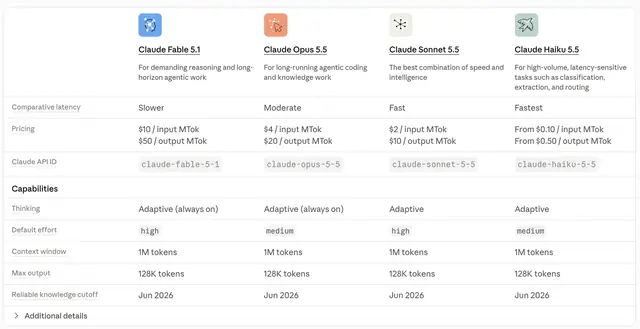
How large language models differ, and what to compare
Context window, reasoning effort, tool use, input types and price per token: how LLMs from Anthropic, OpenAI and Google differ, from their own pages.
Read the post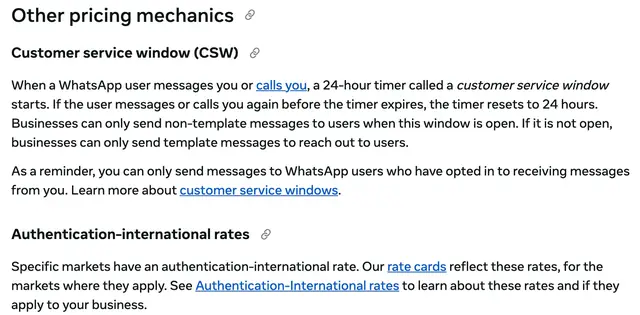
How multilingual WhatsApp agents capture after hours bookings
A WhatsApp agent can answer a 1am booking request in the guest's own language. How Meta's 24 hour window, templates and pricing shape that agent.
Read the post